

The Nuclear Question
Renewable Energy and the Future of Ontario
The trajectory of modern urban growth inevitably hinges on secure and sustainable energy infrastructure. Early research into the evolution of large North American urban agglomerations, specifically Mississauga and the Greater Toronto Area (GTA), initially focused on economic optimism, rapid immigration, and the dynamics of building livable cities. Over time, however, the compounding pressures of severe traffic congestion, skyrocketing housing costs, and strained public services have significantly clouded that outlook. This urban strain is further aggravated by external geopolitical shocks, shifting trade relationships, and rising living costs driven by global oil supply disruptions. Consequently, the conditions for ensuring long-term city livability have become fundamentally linked to how we generate and manage power.
Over the past ten years, these core themes have been consistently woven into a body of research and writing that began with the book Mississauga: Building a Livable City and has since expanded to address evolving global crises. Ongoing analysis of these intersecting issues, spanning urban density, automation, wealth concentration, and changing power grids, is actively updated and can be accessed at buildingmississauga.com.
Expanding urban centers require vastly more electricity at a time when environmental degradation demands a swift exit from fossil fuels. While the province of Ontario has historically anchored its grid in nuclear energy, building new conventional reactors has become an exceedingly slow and financially prohibitive path. Alternative nuclear designs, such as small modular reactors (SMRs), are frequently proposed as modern solutions. However, despite their theoretical promise and emerging variations like floating factory-built units, these technologies remain largely unproven at a commercial scale.
Meanwhile, global energy dynamics have experienced a profound technological shift. Renewable energy technologies, particularly solar and wind, have plummeted in cost and are now significantly cheaper to construct and operate than traditional nuclear power. Furthermore, decentralized renewables lack the catastrophic safety risks and long-term radioactive waste burdens that historically trigger public resistance and widespread nuclear setbacks. While parts of Europe and China are capitalizing on this clean energy boom, Ontario continues to prioritize nuclear expansion over significant renewable deployment.
This article contends that expanding nuclear power is not the only viable pathway to satisfy Ontario’s growing electricity demand. Because renewables have become demonstrably more economical and inherently safer, they warrant a primary role in the provincial strategy. By evaluating international developments—specifically the German energy transition model—this paper explores the realistic applicability of advanced renewable systems in Ontario. It directly contrasts their decentralized agility with the high economic costs and structural inertia of nuclear power.
To properly evaluate these shifting paradigms, this article looks to recent global advancements in clean energy, focusing specifically on the structural evolution of Germany. As a massive, highly industrialized country with an export-oriented economy, Germany provides a real-world test case for whether a manufacturing powerhouse can sustain growth while decoupling from conventional baseload generation. Having completed its historic nuclear phase-out, Germany now relies primarily on renewable technologies. In fact, renewable energy sources accounted for 61.8 percent of Germany's public net electricity generation – the electricity mix that actually comes out of the socket – during the first half of 2026.1
This massive clean energy portfolio is anchored by onshore and offshore wind, which dominate national power production, alongside a surging solar infrastructure that added 11.8 gigawatts of new capacity this year alone.2 By successfully integrating decentralized wind, solar, and emerging utility-scale battery storage into an exceptionally complex grid, the German experience demonstrates that modern economies do not require nuclear expansion to meet heavy industrial demands. This shift provides practical lessons for Ontario's own looming energy transition.
The German Experience with Renewables
Given that the shift away from fossil fuels is environmentally inevitable, two realistic paths remain: build out a new generation of nuclear plants, or develop renewables, primarily wind and solar.
Advocates for nuclear energy in Ontario argue that it remains unmatched as a steady supplier of clean electricity at reasonable prices. Ontario brings 50 years of experience managing large nuclear plants built on its own CANDU technology, fueled by domestically sourced uranium among the best grades in the world. Over those decades, specialized supply chains have developed, sustaining local economies and providing employment for an experienced workforce.
Nuclear advocates also contend that all costs considered, nuclear ultimately proves cheaper than renewables. That claim is contested, however, and recent advances in renewable technology have led many to argue the opposite is now true. The topic is complex and needs to be untangled on both sides.
Ontario's existing nuclear fleet was built decades ago, while new developments — including planned Small Modular Reactors (SMRs) — carry multibillion-dollar price tags, on top of the multiyear, multibillion-dollar refurbishment already underway for the aging plants. SMRs have yet to be built anywhere in the Western world, and as an unproven technology, they have so far been prone to significant cost overruns and repeatedly revised timelines.
Renewables, by contrast, benefit from a large and continually evolving base of multinational expertise, driven forward by technological breakthroughs in solar panels and industrial-scale batteries. The newest wind turbines are also several times more efficient than those built just 15 years ago. The intermittency gap in renewable supply is narrowing, though closing it fully will require adjustments across the entire economy, since fossil-fuel backup plants can not be phased out until a reliable alternative baseline is firmly in place.
Beyond nuclear, Ontario also benefits from abundant hydro power, the cheapest energy source available, and together the two supply 70% to 75% of the province's total electricity demand.3 In that respect, Ontario is in a notably stronger position than Germany, which has only a minuscule hydro supply and still generates roughly 41% of its electricity from coal and gas. Because Germany imports all its gas and oil, it is far more exposed to global market fluctuations — yet it appears to be weathering those pressures remarkably well.4
A closer look at electricity price comparisons between the two jurisdictions helps clarify the choices each is ultimately being compelled to make.5
Renewable Energy Price Comparison
(In CAD or Euro per MWh)
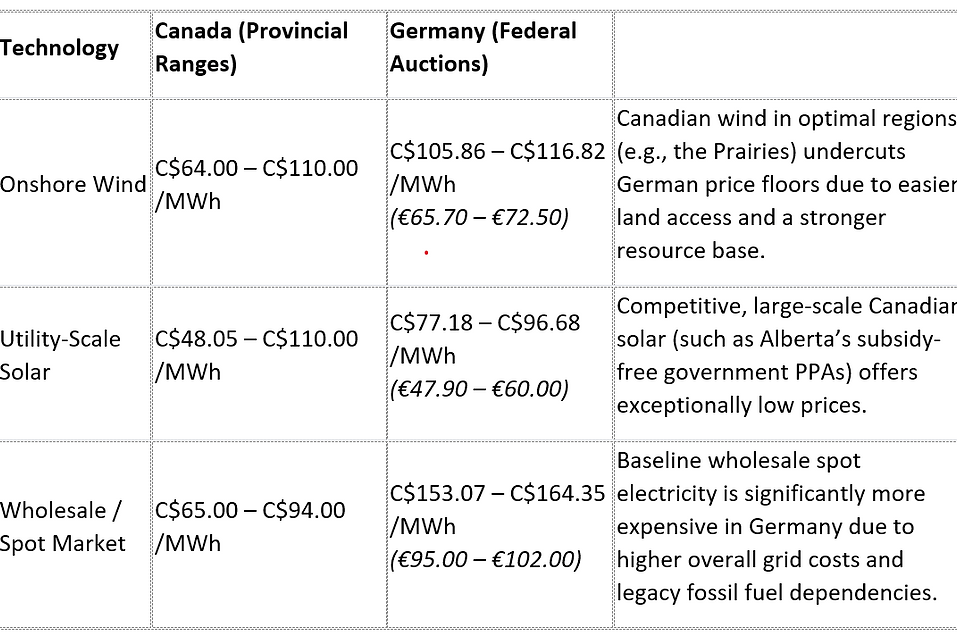
By comparison, the regulated price Ontario Power Generation receives for its nuclear output, set by the Ontario Energy Board (OEB), rose from $111.61/MWh in 2025 to $123.76/MWh in 2026. OPG has applied for rates of roughly $200/MWh or more starting in 2027, driven largely by the costs of refurbishing the Pickering plant and building new capacity; that application awaits OEB approval.6
Interpretation of those cost comparisons requires considering different market conditions in Ontario and Germany. At the first glance cost of electricity produced by Onshore Wind and Solar in Ontario and Germany are close, which reflects the fact that they are dictated by world markets for those technologies. They paradoxically divert dramatically in the Wholesale and Spot Markets, which needs a closer look at the causes.
The nature of Wholesale and Spot Markets
Germany's baseline wholesale spot market is more than double the cost of Canada's provincial averages when mapped head-to-head in Canadian currency.
Even when two regions build wind and solar projects for the exact same hardware and construction costs, the final wholesale price of their overall power grids can look radically different. Those differences can be explained through grid design, geographic baseload layout, and market structure between Germany and Canada.
The German wholesale spot market price of electricity is based on the "marginal cost" of the next available power plant needed to switch on to meet demand. Most Canadian provincial averages, on the other hand, are heavily anchored by vast, low-cost hydroelectric power (e.g., Quebec, British Columbia, Manitoba) or stable nuclear energy (Ontario). Hydro serves as a natural, massive "battery." When the wind stops blowing, Canada turns up the water valves at a marginal cost of near zero.7 By contrast, Germany, who has phased out its nuclear fleet and lacks Canada’s geography for massive hydro, relies heavily on natural gas and coal as its baseload "backup". Even if wind and solar are cheap when operating, the moment the weather changes, expensive fossil fuels set the wholesale market price.
The Nature of the "Spot Market"
Wholesale spot markets utilize a system called marginal pricing. The most expensive power plant required to clear the market sets the price for all electricity sold during that hour.
In Germany, even if solar power costs the same to produce as it does in Canada, solar cannot supply the grid 24/7. During the evening peak, Germany must ramp up natural gas plants.
Because European natural gas prices are historically volatile and significantly higher than North American domestic gas prices, Germany's baseline spot price gets dragged upward for all participants.
Grid Overbuild
Germany has built massive amounts of wind and solar capacity—frequently capable of producing double the country’s peak electricity demand on ideal days.
This causes extreme price swings: during peak sunny/windy hours, wholesale prices drop to zero or go negative. However, to keep the grid from collapsing, grid operators must pay fossil-fuel plants to standby or manage balancing acts. The premium costs required to manage this intense volatility pull the baseline average cost upward.8
Germany has plenty of cheap wind and solar when conditions are perfect, however, because it has to maintain and fire up expensive natural gas and coal plants the moment the weather changes, the extra money paid to those fossil fuel plants pulls the overall year-round baseline average way up.
A Two-Tier Electricity Market
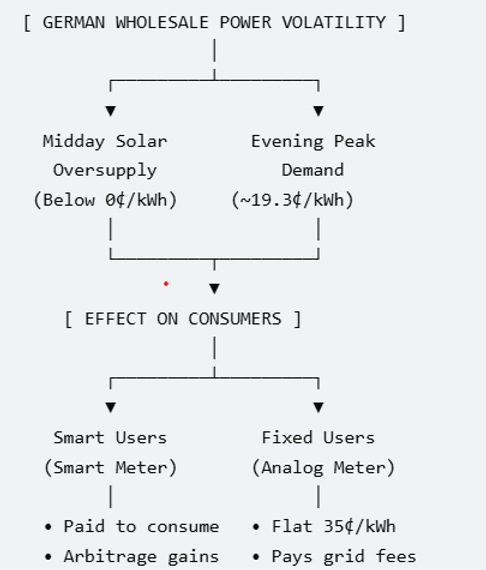
The German wholesale electricity market can swing from roughly €193/MWh (19.3 cents/kWh) at peak evening hours down to near zero, sometimes slightly negative, in the early afternoon. Last year, Germany logged more than 570 hours where wholesale prices dropped below zero, meaning buyers were effectively paid to take electricity off the grid.9
Midday solar generation routinely outpaces demand, flooding the market and collapsing prices, while evening demand without solar support sends prices snapping back toward €190+/MWh. That spread has split German households into two divergent financial realities.10
A growing segment of consumers on dynamic tariffs from providers like Tibber or Ostrom, paired with smart meters, can ride these price swings directly. Germany's regulations require providers to offer such dynamic contracts, giving any household the legal right to opt in. For these consumers, negative pricing becomes a credit rather than an abstraction. Taxes, levies, and network fees, which add up to roughly 23–24 cents/kWh regardless of wholesale price, mean the final bill rarely goes negative outright, but it can fall to a fraction of normal cost during these windows.
The real money is in automation. Home energy management systems shift power-intensive tasks into the cheapest hours, and EV owners time charging to coincide with negative pricing.
Battery operators capture the widest gains by charging cheap and using or reselling at peak, while heat pump users pre-heat during low-cost windows to coast through expensive ones. These households have effectively turned grid volatility into a source of passive savings, though only because they have made the upfront investment in hardware and contracts needed to participate.
Meanwhile, the average household still on a traditional fixed-rate contract, paying something like a flat 35 cents/kWh around the clock, experiences none of this. Whether the wholesale price is €193/MWh or negative makes no difference to their bill. This creates two compounding disadvantages: with roughly 6% of the year seeing near-zero or negative wholesale prices, fixed-rate consumers are structurally locked out of that savings window, and the same oversupply that creates negative pricing also strains the grid, requiring transmission operators to spend heavily on stabilization. Those costs are passed back to consumers through rising grid fees, which already make up close to 28% of a standard household's bill. The fixed-rate consumer ends up with no access to the cheap hours but a growing share of their bill reflecting the cost of managing volatility they cannot benefit from.
A structural divide is emerging in Germany. A grid with a high share of renewables rewards households that have the technology and tariffs to respond to its rhythm, while penalizing all others. As solar and wind capacity grows, the number of negative-price hours is likely to increase, widening the gap between smart energy households and the traditional majority in Germany, who pay a flat rate in an increasingly uneven market.
Managing Extreme Energy Price Swings
Rather than relying on direct cash handouts, Germany addresses its massive wholesale price swings through market-enforced regulatory reform, grid upgrades, and legal exemptions that push renewable operators toward self-regulation and large-scale battery buildout.
The swings trace back to legacy subsidy design. Under the historical Renewable Energy Sources Act (EEG), older wind and solar farms receive fixed feed-in premiums regardless of market conditions, so they keep generating even when wholesale prices crash past -€100/MWh toward -€250/MWh, since they get paid either way. This drives the generation surpluses and grid stress behind the price collapses.
The governmental response, the Solarspitzengesetz, amends Section 51 of the Renewable Energy Sources Act (EEG) to automatically suspend feed-in subsidies for new installations during any 15-minute interval when prices turn negative, with state payments halted entirely during negative hours by 2027. New projects must now either shut down dynamically when the grid is saturated or build batteries to store their own output.
The deeper structural problem is a mismatch between generation and storage capacity. On sunny holidays, German solar output can exceed 117 GW while total grid consumption falls to just 40–41 GW. With only about 2.4 GW of utility-scale battery storage nationwide, existing batteries fill within an hour, leaving enormous surpluses with nowhere to go. A pipeline is underway to close that gap: falling lithium battery (LFP) costs and wide peak-to-evening price spreads are driving roughly 10.5 GW / 26.3 GWh of announced grid-scale battery projects, enough to absorb more than a third of currently curtailed solar and wind power and meaningfully flatten the deepest negative-price dips.
To accelerate that buildout without straining the federal budget, the government leans on regulatory exemptions rather than subsidies. Amendments to the Energy Industry Act (EnWG) exempt storage facilities commissioned before August 4, 2029 from grid fees and eliminate double charging, so batteries are no longer taxed both when drawing power and when discharging it. New co-charging rules (MiSpeL), enacted by the Bundesnetzagentur in October 2026, let large-scale batteries engage in pure energy arbitrage — charging cheaply at midday and discharging at evening peaks — without forfeiting their statutory EEG green-energy premiums.11
Home Battery and EV Grid Integration
The German path away from severe negative wholesale price spikes runs through the building where the power is used, not just through the plant where it is generated.
By combining home batteries with electric vehicles, the country is unlocking over 100 GWh of latent decentralized capacity capable of automatically absorbing midday solar surpluses and balancing the grid from below.
On the residential side, Germany already leads Europe with more than two million home batteries installed, representing over 20 GWh of storage capacity.12 These batteries only help the grid if something controls when they charge and discharge — that control comes from the digital layer underneath them.
Germany lagged badly on smart meters, sitting at just 1% coverage in 2023 versus 80%+ in countries like Spain or Sweden, but a 2023 law made rollouts mandatory starting in 2025. Smart meters record usage at short intervals, which enables the variable, time-of-use tariffs now required by law. A Home Energy Management System uses that live data to detect wholesale price drops and automatically route cheap or sub-zero midday solar power into home batteries. The payoff compounds: better integration of this 20+ GWh residential ecosystem lowers systemic costs, protects the grid from oversupply strain, and turns negative pricing into efficient self-consumption rather than waste.
The second, larger opportunity lies in driveways. Because passenger cars spend roughly 95% of their lives parked, Germany's growing EV fleet is effectively a massive, decentralized storage network waiting to be tapped.13 The immediate version of this is smart managed charging, where vehicles use digital communication standards to delay their charging cycles until midday solar generation peaks rather than drawing power the moment they're plugged in. Fleet aggregators shift charging into those low-price windows, and EV owners get rewarded with exceptionally cheap, sometimes free, electricity through dynamic pricing.
The more transformative step is bidirectional charging, which allows electric vehicles to supply power back to the grid as well as draw from it, effectively functioning as small power plants.14 In late 2025, Parliament amended the Energy Industry Act to eliminate double-taxation grid fees on stored power, effective January 2026, so energy returned to the grid from a vehicle is now taxed the same as standard utility storage. The Federal Network Agency's MiSpeL framework standardizes safe, economical bidirectional feed-ins, and automakers are already commercializing the technology at scale, with Volkswagen's Elli subsidiary rolling out EV platforms pre-equipped for two-way power flow.
Three friction points still slow full-scale adoption. Workplace charging lags far behind home infrastructure, as midday solar peaks occur when most cars are parked at offices rather than at homes. A €500 million subsidy program is now funding pre-cabled, bidirectional chargers at multi-unit housing and SMEs to close that gap.15 Hardware rollout is also slower than the technology allows: while the ISO 15118 protocol mandates "Plug & Charge" and bidirectional workflows on public AC chargers, upgrading millions of analog meters in older residential buildings remains a genuine bottleneck.
Looking further out, the trajectory is toward disappearance rather than management of the problem. As home storage, flexible EV charging, and utility-scale hydrogen electrolyzers fully scale, deeply negative price penalties should fade, and the wholesale market will settle closer to "zero hours" around €0/MWh. At that point, the financial risk for clean energy developers shifts: instead of paying penalties for negative prices, the challenge becomes a volume problem, where the grid is balanced but clean generation is so abundant it can no longer command a premium.
The Two German Offshore Giants
While batteries and EVs solve the demand side of Germany's energy equation by soaking up surplus power where it's consumed, an equally significant shift has been happening on the supply side. Two newly launched offshore wind farms in the North Sea show that generation itself is maturing past the need for government support altogether.
The launches of Borkum Riffgrund 3 (913 MW) and He Dreiht (960 MW) have added a combined 1,873 MW of clean capacity to the national grid. More significantly, these are the first mega-scale offshore wind farms ever built without government subsidy — a genuine milestone in global energy economics.
That shift traces back to Germany's 2017 offshore wind auction, where developers broke from decades of precedent by submitting "zero-cent bids" of €0/MWh instead of demanding the state-backed feed-in tariffs that had long underwritten offshore wind's high capital costs and sea-based risk.16 In doing so, they committed to financing multi-billion-euro projects entirely through private markets, signaling that offshore wind technology had matured enough to compete without taxpayer support.17
He Dreiht, developed by EnBW at a cost of €2.4 billion, is now Germany's largest single offshore project. Its 64 Vestas turbines, each rated at 15 MW, generate more than six times the output of EnBW's original 2010-era 2.3 MW units — a leap that has fundamentally reshaped North Sea wind economics. The farm delivered its first electricity on November 26.18
Borkum Riffgrund 3, inaugurated by Danish developer Ørsted alongside infrastructure investor Nuveen, sits roughly 72 kilometers off Germany's coast and runs 83 Siemens Gamesa turbines, each rated at 11 MW with a 200-meter rotor diameter. It's expected to produce around 4 TWh annually, enough to theoretically power nearly one million German households.19
With no subsidies underwriting either project, both developers leaned on long-term corporate Power Purchase Agreements to secure predictable revenue. The output of Borkum Riffgrund 3 is largely locked into industrial and technology contracts with Amazon (350 MW), BASF (186 MW), Covestro (100 MW), REWE Group (100 MW), and Google (50 MW). He Dreiht secured similar backing from Google, Deutsche Bahn, and DHL Group.
Whatever capacity is not contracted through these PPAs is sold as merchant energy directly into the wholesale market, where returns depend entirely on spot prices. German offshore wind has historically captured between €70 and €85 per MWh in that open market — exposing developers to volatility but also letting them capture upside when demand peaks.
The Two Germanies
However, generating record volumes of subsidy-free wind power in the North Sea solves only half the problem — that electricity still has to reach the factories and cities hundreds of kilometers away, exposing one of Germany's most stubborn infrastructure challenges.
Germany's renewable buildout has created a geographic mismatch that has come to be known as the "Two Germanies" problem. In the south, states like Bavaria and Baden-Württemberg form the country's industrial core — home to major automakers, engineering firms, and a dense population that has traditionally drawn power from nuclear and coal plants, many of which have since closed. The south does have strong solar potential and actually leads the country in rooftop installations, but it lacks the consistent, large-scale wind resources needed to replace baseload power at the volumes its industry demands.20
The north, meanwhile, is where that wind power is being generated in abundance. The result is a straightforward but costly mismatch: electricity production is increasingly concentrated hundreds of kilometers from where it's consumed. Germany's existing grid was only designed around power plants sited close to the cities and industrial zones they served, and the traditional alternating current (AC) system it relies on loses efficiency and becomes harder to control over very long distances.
The fix is a new generation of High Voltage Direct Current (HVDC) transmission lines, most of which are slated for completion by 2030. The flagship project, SuedLink, is a 700-kilometer, €10 billion transmission corridor that will carry power at 525 kilovolts from Schleswig-Holstein in the north to Baden-Württemberg in the south when it comes online in 2028. HVDC was chosen specifically because it can move much larger volumes of power over long distances with lower transmission losses than conventional AC lines allow.
Germany Accelerating Fossil Fuel Exit
Linking the wind farms of the north to the factories of the south resolves only one part of the challenge facing the grid. Storing the surplus energy is the next hurdle, and it leads directly to the larger imperative behind all of these efforts: eliminating fossil fuels, and coal in particular, for good.
Managing renewable energy spikes is a technical challenge, but the deeper driver of the energy transition program (Energiewende) is the recognition that fossil fuels are the primary cause of environmental degradation, now treated as an existential risk rather than a distant concern. That transition has been severely tested by geopolitical shocks, particularly the war in Ukraine and the conflict involving Iran, both of which disrupted traditional oil and gas supplies to Germany and triggered global price spikes.
The deep investment in renewables in Germany cushioned the blow, keeping energy prices stable enough to continue the push toward coal elimination rather than retreat from it. Germany is legally bound to phase out coal-fired power by 2038 at the latest, but market dynamics suggest the real exit will arrive much sooner, likely between 2031 and 2035. In September 2026, the German cabinet formally approved a climate roadmap confirming a full fossil fuel exit by 2045, with active discussion underway to move the legal coal deadline forward to 2035.21
Economics are doing much of the work that regulation once had to force. Under the Emissions Trading System of the European Union, high carbon allowance prices increasingly penalize the burning of lignite and hard coal. Research by the Öko-Institut suggests that carbon pricing alone will likely drive a market-based coal exit by 2031 or 2032, simply because continuing to operate the plants will become unprofitable. Compounding this, structural exit laws beginning in 2027 end state financial compensation for hard coal plants, leaving utilities fully exposed to those market losses.22
Yet despite cheap renewables and increasingly expensive coal, Germany still operates roughly 28 GW of coal capacity, held in place by a dependency chain that runs through the same storage gap described earlier: renewable surges collapse midday prices, but without enough storage to carry that cheap power into the evening, coal and gas still have to fire up to cover peak demand. The problem compounds in winter, during extended stretches of low wind and low sun known as Dunkelflaute, when neither EVs nor grid-scale batteries can bridge gaps lasting weeks rather than hours.
To retire coal safely, Germany is building flexible, hydrogen-ready natural gas plants that emit half the CO₂ of coal and can ramp up within minutes. Hydrogen-ready natural gas power plants are modern thermal generating stations designed to burn standard natural gas today but engineered so they can be easily converted to burn up to 100% clean hydrogen fuel in the future.23
The actual bottleneck is the scarcity of green hydrogen (hydrogen produced using renewable electricity to split water). Until a massive regional pipeline network and industrial scale electrolyzers are built, these plants will spend their early operational lives running predominantly on standard natural gas.
Meanwhile, the Federal Network Agency has postponed the final grid security assessment to 2027, to confirm that the new gas auctions and battery pipelines are robust enough to cover the remaining coal capacity.24
The resulting timeline for retiring coal unfolds in stages. By 2030, western Germany aims to be virtually coal-free through an accelerated agreement with RWE AG. Between 2031 and 2035, carbon pricing combined with a maturing EV and battery storage network is expected to make eastern German coal plants unprofitable, driving the final wave of market-based retirements. And 2038 remains the hard legal backstop for any capacity still standing by then.
Green Energy Additions Worldwide in 2026
The experience of Germany, marked by rapid renewable growth, grid bottlenecks, a scramble for storage, and a race to retire fossil fuels, is not an isolated story. It presents a preview of a transformation now unfolding at global scale.
Renewable capacity additions are breaking records worldwide, with renewables now accounting for nearly 50% of total global installed capacity. According to the International Energy Agency, global annual renewable capacity additions rose 16% in 2025 to reach 800 GW, despite ongoing supply chain strain, grid connection delays, financing pressures, and shifting policy landscapes. It was the 23rd consecutive year renewables set a new expansion record. Solar PV drove more than three-quarters of that growth, with wind contributing another 20% and the remainder split among hydropower, bioenergy, geothermal, concentrating solar, and marine energy.25
Electricity Demand, Clean Generation and Emissions

Note: The European Union emissions value is left blank because it was not provided in the source text.
Globally, electricity demand reached 31,779 TWh in 2025, with clean sources supplying 43% of it and wind and solar alone accounting for 17% (a terawatt-hour equals 1,000 gigawatt-hours). That clean generation grew by 887 TWh year-on-year, even as the world still emitted 14,564 billion metric tons of carbon dioxide (CO₂) from the remaining fossil-fuel share.
China Leads Renewables
This growth is heavily concentrated in a few powerhouse economies, with China, the European Union, and India together driving roughly 80% of the global total.China Leads Renewables China remains the undisputed leader, accounting for over 60% of all global solar installations and adding roughly 500 GW of renewable capacity in its most recent tracking cycle alone — split between 370-415 GW of solar and 117-119 GW of wind. That pushed its total non-fossil capacity to 2.46 TW, now 62% of its entire grid mix.The European Union added between 67 and 85 GW of clean capacity, with solar contributing about 70 GW of that total, led by Germany with 17 GW and Spain with 14 GW.
Renewable generation across the bloc has now structurally overtaken combined fossil-fuel generation. India, meanwhile, saw clean tech deployment accelerate by 60%, adding roughly 50 GW of solar and over 6 GW of wind — enough to push it past the United States as the world's second-largest solar market.
Beyond the top three, the pattern repeats with local variations. The United States added 43 to 49 GW of renewables, a slight 10% dip tied to integration hurdles, but led the world in grid stabilization by deploying nearly 15 GW of new battery storage to counter the same midday price collapses Germany has wrestled with. Saudi Arabia added about 7 GW of solar as part of a broader Middle East and North Africa push that doubled regional additions, and Pakistan added roughly 10 GW of solar through rapid consumer and utility adoption.
Across all these markets, the same technology hierarchy holds: solar PV accounts for more than 75% of new additions worldwide, wind contributes about 20% with offshore capacity scaling fast in Europe and China, and battery storage is surging everywhere as grid integration becomes the shared bottleneck — with Germany and Australia each adding roughly 5 GW of storage, trailing only the United States.
Data Centers and the New Demand Surge
This global surge in renewable buildout is about to meet an equally powerful new source of demand: the explosive growth of data centers worldwide — a trend already reshaping energy planning from the American desert to the suburbs of Toronto.
The rapidly rising energy consumption of data centers supporting AI and cryptocurrency operations, a demand that has already surpassed that of heavy industry, as noted earlier, has received little attention in energy planning in Ontario. It merits a closer look, starting with the U.S. experience, where the issue has drawn far more public scrutiny and warning.
Economist Paul Krugman has argued that data centers have become one of the most visible and tangible symbols of the real-world costs of AI: they consume enormous tracts of land, draw massive amounts of electricity and water, and when they generate their own power on-site, create significant local pollution. He connects this backlash to a broader public unease with the tech billionaires driving the AI boom and the concentration of wealth and influence they represent.26 That unease shows up in the polling: a Reuters/Ipsos survey found that 57% of Americans, including two-thirds of Democrats and half of Republicans, would oppose a data center being built in their own neighborhood.27
Utah has become the clearest test case for that opposition. Canadian venture capitalist Kevin O'Leary secured approval to build Stratos, billed as the world's largest server farm, on a site more than double the size of Manhattan — a plan that has triggered significant public backlash and nearly 4,000 formal objections over its energy and water demands in a drought-stressed region.28
Rob Davies, a physics professor at Utah State University, has laid out just how severe that impact could be. To deliver the 9 GW of power Stratos needs, the supporting plant would actually have to generate around 16 GW of primary energy, since the plant operates at roughly 55% efficiency — meaning nearly 7 GW is lost as waste heat. Cooling that load requires a dry-air cooling system spanning 200 to 400 acres packed with thousands of industrial fans running continuously. Because the site sits in a high-desert valley prone to nightly temperature inversions that trap air and prevent it from circulating, that waste heat doesn't dissipate — it accumulates, potentially raising nighttime temperatures by 8 to 13°F (roughly 4 to 7°C).
Davies summarized the effect memorably: the project amounts to "a 400-acre hair dryer blowing hot air into the valley, 24/7/365." 29 Davies also warns the project threatens the already-shrinking Great Salt Lake, including critical migratory bird habitat, and could expose nearby Salt Lake City to toxic dust as the lakebed continues to dry. Notably, he calculates that had the plant been nuclear rather than gas-fired, the thermal burden would be even worse — closer to 27 GW — since nuclear plants run at only about 33% efficiency compared to natural gas's 45–55%.
Data Centers in Ontario
Ontario is facing structurally similar version of this challenge. The province already hosts an estimated 100 to 200 or more operational data centers, with the Toronto region serving as the primary hub in Canada.
Growth is spreading outward into Markham and Richmond Hill, now informally known as the “AI corridor” of the Greater Toronto Area, along with Mississauga, Brampton, Etobicoke, and the fast-expanding Vaughan and York Region belt, with Ottawa serving as a secondary hub.30 The electricity grid of Ontario peaks at roughly 20,000 to 24,000 MW in summer, covering every sector of provincial demand. Data centers currently draw an estimated 500 to 1,500 MW on average, with peak connected capacity in the 1,000 to 2,500 MW range, concentrated heavily in the GTA — meaning they already account for roughly 3% to 8% of total electricity use in Ontario at any given time.
Official provincial projections suggest data centers will account for about 13% of all new electricity demand by 2035, or roughly one in every eight new megawatts added to the grid. With proposals currently in the pipeline totaling 2,000 to 6,500 MW of planned capacity, data centers are on track to become one of the top three electricity demand sectors in Ontario by 2035, rivaling heavy industry and the combined electrification of transportation and heating.
Conclusion
This chapter’s exploration of renewable energy developments was framed against the current Ontario government’s position that surging electricity demand can only be met through a decisive expansion of the province’s nuclear fleet. That argument rests on the acknowledgment that Ontario’s nuclear plants already meet over half of current demand and have operated for decades without a major incident, delivering a steady, reliable supply of power. Premier Doug Ford campaigned on the view that renewables, wind power especially, were too costly and should be phased out. He has since softened that position but continues to treat nuclear as the cornerstone of Ontario’s energy future, launching preliminary work on Small Modular Reactors (SMRs) next to the existing Darlington plant. SMRs, however, remain an unproven technology in the Western world — no such plant has yet been built outside China and Russia, and the two that exist there have drawn mixed reviews.
Renewables, meanwhile, have advanced considerably worldwide, and Germany’s experience offers compelling evidence of their viability: solar and wind now supply 55% to 60% of the country’s electricity consumption. The German government continues to drive its energy transition, the Energiewende, through support for both large distributors and individual consumers, even as it gradually winds down subsidies. This year alone saw the activation of the North Sea’s two largest offshore wind farms: Borkum Riffgrund 3, capable of powering nearly a million German households, and He Dreiht, Germany’s largest offshore project, built with Vestas turbines six times more efficient than those installed 15 years ago, each capable of powering roughly 10,000 homes. Both were developed entirely without government subsidy, relying solely on private investment — a striking contrast to Ontario’s nuclear plans, which depend heavily on public funding as private investors remain hesitant or are withdrawing support altogether.
The renewable surplus in Germany poses its own challenges. Solar and wind output occasionally reaches twice actual demand, driving prices to zero and forcing surplus power to be exported or wasted due to insufficient storage. In response, the government is encouraging large-scale battery storage (BESS) to bank cheap midday power for evening peak demand, alongside bidirectional EV charging that allows electric vehicle batteries to absorb surplus power and release it when demand surges. This renewable foundation has also given Germany real insulation from global energy shocks, allowing it to weather the oil and gas price volatility triggered by the wars in Ukraine and Iran while keeping domestic electricity prices comparatively stable.
Notably, Germany’s export-driven economy runs largely on renewables without any nuclear power at all. It still depends on coal and gas for roughly 40% of total supply, necessary for the days-long stretches in winter when neither sun nor wind cooperate (the Dunkelflaute). But the government has a firm plan to phase out coal by 2038, likely several years sooner, with gas plants gradually transitioning to hydrogen as clean supply becomes available at scale.
Demand pressure is intensifying further, in Germany and elsewhere, as data centers expand rapidly and place growing strain on electrical grids. This is a global pattern, not a German one: clean generation worldwide grew by 887 TWh year-on-year, led overwhelmingly by China’s 561 TWh, well ahead of the United States (105 TWh) and India (97 TWh), with the European Union close behind China as the next-largest producer of clean energy. Canada is part of this same trajectory. Large solar and wind projects are already in the planning stages, including a major offshore development by World Energy GH2 in Stephenville, Newfoundland, which will produce both electricity and clean hydrogen. Canada is already a significant hydrogen producer, with exports bringing in roughly $6 billion annually as global demand for hydrogen as a fossil fuel substitute continues to grow.
Taken together, these developments suggest that Ontario’s energy future does not have to rest on nuclear power. Renewable energy projects have proven they can compete and win, offering electricity that is often cheaper and no less reliable, while new nuclear technologies remain years from maturity and carry significant cost and schedule risk. A clear-eyed assessment of these global trends in renewable energy offers the strongest foundation for policy that can withstand the test of time.
References:
1. Fraunhofer Institute for Solar Energy Systems ISE. (2026, July 2). Solar power on the rise across Europe [Press release]. https://www.ise.fraunhofer.de/en/press-media/press-releases/2026/solar-power-on-the-rise-across-europe.html;
Ivanova, T. (2026, October 1). Renewables reach record 60.7% share of German power use in Jan-Sep. Renewables Now. https://renewablesnow.com/news/renewables-reach-record-60-7-percent-share-of-german-power-use-in-jan-sep-1302249/
2. Solar Now. (2026, September 17). Germany's August 2026 solar installations exceed 1.6 GW – TaiyangNews. https://now.solar/2026/09/17/germanys-august-2026-solar-installations-exceed-1-6-gw-taiyangnews/;
Fraunhofer Institute for Solar Energy Systems ISE. (2026, January 1). German public electricity generation in 2025: Wind and solar power take the lead for the first time [Press release]. https://www.ise.fraunhofer.de/en/press-media/press-releases/2026/german-public-electricity-generation-in-2025-wind-and-solar-power-take-the-lead.html
3. CW Hydro. (2026, July 7). Ontario's system-wide electricity supply mix: 2025 data. https://www.cwhydro.ca/ontarios-system-wide-electricity-supply-mix-2022-data/
4. Gandhi, L., & Burger, B. (2026, July 1). Electricity generation in the first half of 2026: Solar power continues to advance across Europe [Press release]. Energy-Charts. https://www.energy-charts.info/post.html?l=en&c=DE&q=electricity_generation_in_the_first_half_of_2026_solar_power_continues_to_advance_across_europe_07012026
5. Bundesnetzagentur. (n.d.). SMARD: Market data. https://www.smard.de/en;
Pickup, D., & Noel, W. (2026, January 28). Canadian solar and wind project costs plummet: Renewables are now most affordable new generation, as costs are halved. Pembina Institute. https://www.pembina.org/blog/canadian-solar-wind-project-costs-plummet
6. Niagara-on-the-Lake Hydro. (2026, January 23). OPG rate increase for nuclear power. https://www.notlhydro.com/opg-rate-increase-for-nuclear-power/
7. Canada Energy Regulator. (2026, March 4). Market snapshot: How much do your neighbours across Canada pay for electricity? https://www.cer-rec.gc.ca/en/data-analysis/energy-markets/market-snapshots/2026/market-snapshot-how-much-do-your-neighbours-across-canada-pay-for-electricity.html
8. Hirth, L. (2026, September 8). Do wind and solar curtail at negative electricity prices? Incentives and evidence across two decades of German renewable support schemes. Hertie School & Neon Neue Energieökonomik. https://arxiv.org/pdf/2609.10053
9. Romero, P. G. (2026, July 21). Negative electricity prices in Europe: What drives different market outcomes? Haya Energy. https://hayaenergy.com/blog_2026_negative-electricity-prices-in-europe/
10. 3E. (2026, February 25). Navigating Germany’s Netzpaket and Solarspitzengesetz: A practical guide for solar asset owners. https://www.3e.eu/resources/blogs/germany-netzpaket-practical-guide-for-solar-asset-owners
11. Review Energy. (2026, October 2). Germany approves new rules to integrate batteries and bidirectional charging into the electricity market. https://www.review-energy.com/almacenamiento/germany-approves-new-rules-to-integrate-batteries-and-bidirectional-charging-into-the-electricity-market
12. Electrical Technology. (2026, July 20). Germany's home battery boom: Why millions are storing solar power instead of buying fossil-fuel electricity [Facebook post]. Facebook. https://www.facebook.com/electricaltechnology.info/photos/germanys-home-battery-boom-why-millions-are-storing-solar-power-instead-of-buyin/1333572485614565/
13. International Energy Agency. (2026, May 20). Vehicle-to-grid technology. https://www.iea.org/reports/vehicle-to-grid-technology
14. GridX. (2026, September 11). Vehicle-to-grid (V2G) and vehicle-to-home (V2H) technology. https://www.gridx.ai/knowledge/vehicle-to-grid-v2g-and-vehicle-to-home-v2h
15. NOW GmbH. (2026, March 25). Schnieder: 500 million euros for charging infrastructure at apartment buildings [Press release]. https://www.now-gmbh.de/en/news/pressreleases/schnieder-500-million-euros-for-charging-infrastructure-at-apartment-buildings/
16. Franke, A. (2025, November 26). Germany's biggest offshore wind project delivers first power. S&P Global Commodity Insights. https://www.spglobal.com/energy/en/news-research/latest-news/electric-power/112625-germanys-biggest-offshore-wind-project-delivers-first-power
17. Argus Media. (2017, April 13). Zero subsidies for German offshore farm in 2025. https://www.argusmedia.com/en/news-and-insights/latest-market-news/1442237-zero-subsidies-for-german-offshore-farm-in-2025
18. EnBW. (n.d.). He Dreiht offshore wind farm: Powerful energy in the North Sea without state funding. https://www.enbw.com/company/topics/wind-power/offshore-wind-farm-he-dreiht/
19. Ocean Energy Resources. (2026, September 24). Ørsted and Nuveen inaugurate 913 MW OWF in Germany. https://ocean-energyresources.com/2026/09/24/orsted-and-nuveen-inaugurate-913-mw-owf-in-germany/
20. Balasubramanian, K. (2025, May 12). Germany's green power race: North vs. South in sustainable energy innovation. Illuminem. https://illuminem.com/illuminemvoices/germanys-green-power-race-north-vs-south-in-sustainable-energy-innovation
21. Bundesministerium für Umwelt (German Federal Ministry for the Environment). (2026, September). Germany's roadmap for transitioning away from fossil fuels. https://www.bundesumweltministerium.de/fileadmin/Daten_BMU/Download_PDF/Klimaschutz/taff_roadmap_en_bf.pdf
22. Wehrmann, B. (2026, April 21). Germany's coal exit quietly progressing, likely completed by 2032 – researcher. Clean Energy Wire. https://www.cleanenergywire.org/news/germanys-coal-exit-quietly-progressing-and-likely-be-completed-2032-researcher
23. Gathmann, M. (2025, January 19). From coal to gas, from gas to hydrogen. Siemens Energy. https://www.siemens-energy.com/global/en/home/stories/leipzig-energy-transition-coal-gas-hydrogen.html
24. International Energy Agency. (2026). Technology: Solar PV and wind. In Global Energy Review 2026. https://www.iea.org/reports/global-energy-review-2026/technology-solar-pv-and-wind
25 Ember. (2026, April 21). Major countries and regions: Overview of the global power sector in 2025. In Global Electricity Review 2026. https://ember-energy.org/latest-insights/global-electricity-review-2026/major-countries-and-regions/
26. Krugman, P. (2026, June 25). Why does everyone hate AI? It's the fear, the enshittification, datacenter hostility, and the tech broligarchy. Paul Krugman (Substack). https://paulkrugman.substack.com/
27. Ipsos. (2026, May 8). AI data centers are unpopular with most Americans. https://www.ipsos.com/en-us/ai-data-centers-are-unpopular-most-americans
28. Milman, O. (2026, May 13). 'Irresponsible': Backlash as Utah approves datacenter twice the size of Manhattan: Facility would require more power than entire state uses and suck up vast amount of water in drought-stricken area. The Guardian. https://www.theguardian.com/us-news/2026/may/13/utah-approves-datacenter-backlash
29. Davies, R. (2026, May 5). Stratos Project: Thermal load summary [PDF]. Google Drive. https://drive.google.com/file/d/1pFqgfN6nF1vos8LRRMpsvTK3qpvE5Tjf/view
30. Ontario Newsroom. (2025, July 2). Ontario's energy plan unlocking opportunities in the digital economy: New measures will prioritize electricity for data centres that create good-paying jobs and strengthen Ontario's economy. https://news.ontario.ca/en/release/1006141/ontarios-energy-plan-unlocking-opportunities-in-the-digital-economy