

Nuclear Energy Revisited
As the twenty-first century advances, humanity faces an unprecedented challenge: meeting the world’s growing energy demands while curbing the environmental damage caused by fossil fuel dependence. Rising global populations, rapid industrialization, and the escalating effects of climate change have placed energy systems at the center of debates about sustainability and economic development.
In response, renewable technologies such as solar, wind, and hydrogen power have emerged as promising alternatives, offering the potential to decouple economic growth from carbon emissions. However, the transition to a sustainable energy future is not without obstacles, including infrastructure limitations, political resistance, and the economic costs of transformation. This essay argues that a successful shift toward future energy systems will require not only technological innovation but also coordinated policy reform and international cooperation, positioning renewable energy as both an environmental necessity and an economic opportunity.
Our societies are increasingly dependent on energy supplies. While people in preindustrial societies managed to satisfy their needs by relying mostly on their own physical strength, walking and working with their hands, that changed with the advent of steam power, which in turn was supplanted by internal combustion engines and electricity. Coal is still used in firing power plants, often being replaced by natural gas.
Some 70 years ago, a new source of energy was successfully harnessed by controlling nuclear fission and building the first nuclear power facilities. Canada was among the pioneers in this field. Today the three nuclear power plants are the main energy source in Ontario.
Meanwhile, economies in developed countries continue to rely predominantly on fossil fuels: coal- or gas-fired power plants supply electricity, while transportation—automobiles, shipping, freight, and aviation—remains powered largely by oil products. However, due to their ecological impact, increasing attention is being directed toward nuclear energy and renewables as alternatives.
There is growing recognition that averting ecological collapse will require phasing out fossil fuels, the largest contributors to carbon emissions, in the near future. This leaves policymakers debating whether to prioritize the rapid expansion of nuclear energy or renewable energy—chiefly wind and solar—since most viable opportunities for hydroelectric power have already been developed.
Renewable energy—hydroelectric, geothermal, solar, wind, and biofuel power—offers considerable opportunities, as much of it derives ultimately from solar energy, whether converted directly into electricity by photovoltaic panels or harnessed through wind turbines. Yet its expansion meets vocal opposition from competing interest groups: some remain committed to fossil fuels, while others advocate instead for a massive buildup of nuclear power.
In the United States, the Trump administration has been notably hostile toward renewables, instead favouring continued coal production in addition to expanded oil and gas extraction through shale technologies. Critics attribute this stance to the political influence of coal mining and oil extraction interests, who have contributed substantially to Trump-aligned political and financial entities, and who have also funded publicity campaigns critical of renewable energy1.
The experience of the last decade, however, supplies evidence that renewables are both economically justified and the only viable way to produce increasing amounts of energy without further destabilizing the environment. It has been demonstrated that electricity generated by renewable technologies is now often cheaper than that derived from either fossil fuels or nuclear power plants. This chapter is devoted to examining scientific evidence for the viability of renewable energy and to tracing recent developments in new nuclear technologies.
It is expected that Ontario, the most populous province of Canada, with its fast growing population – currently of more than 16 million – will require significant growth of electricity output to sustain the economy. The Independent Electricity System Operator (IESO) projected that due to rapid electrification, population growth, and industrial expansion, Ontario’s electricity generation capacity should more than double by 2050, with significant demand surges and capacity needs emerging through the 2030s2.
Based on these projections, the government of Doug Ford adopted a plan of comprehensive development of electricity generation for the 2030s and onward till 2050. It states that “in less than 30 years Ontario could need more than double its electricity generating capacity, from 42,000 megawatts (MW) today to 88,000 MW in 2050. Up to 20,000 MW in capacity may be needed just to replace generation that will come to the end of its life or be phased out over the next three decades.”3
The previous Liberal government of Dalton McGuinty, struggling with the increasingly dense smog blanketing Toronto, spearheaded the elimination of coal-fired power plants. The Mississauga Lakeview Generating Station, once considered the largest coal-fired plant in the world, was dismantled in 2006. An attempt to recover the lost power by building a large gas-fired plant in Mississauga met with vocal opposition from the residents and was abandoned with significant financial loss. From then on, the discussion of future power generation revolved around nuclear power, gas-fired power plants away from large population centers and on renewable energy, especially the windfarms.
In less than a year a large windfarm was erected in the Melancthon Township, about 100 kilometers northwest of Toronto. Today, the facility consists of 133 operational turbines and generates around 200 MW of power, which is enough to supply roughly 50,000 homes.
However, the early contracts for energy providers proved to be expensive, raising fears of large increases to rate payers, which hastened the victory of the Progressive Conservatives, led by current premier Doug Ford, who vowed to put an end to all windfarm projects. Indeed, many of them were cancelled in the first years of his tenure. That would leave only two options for future energy: more gas-powered plants and nuclear energy, which would be expanded considerably.
In the following years plans were developed to build a new power plant at Bruce Nuclear station on the shores of Lake Huron, as well as expand the Darlington station east of Toronto by a new type of Small Modular Reactor (SMR). Practice, however, proved to be more complicated than originally assumed. At the same time, large drops in renewable energy prices and the rapid proliferation of renewable energy projects around the world made the Ford government review its options, which found expression in the Powering Ontario’s Growth plan.
Although nuclear energy, along with gas-fired plants, remains the mainstay of energy supply in Ford’s plans, renewables are recognized as a relevant backup source. The intermittency of power supply by wind and solar farms is to be remedied by rapidly developing technologies of massive storage batteries, the so-called Battery Energy Storage System (BESS). Also, other sources of renewable energy are taken into account, like biofuels and use of hydrogen.
The magnitude of the Ford government’s shift is large in absolute terms — from actively dismantling wind infrastructure to committing to 5,000–7,500 MW of new renewable capacity, yet nuclear and gas still anchor the long-term plan. We will consider the implications in detail4.
Ontario’s government has described nuclear as one of the province’s lowest-cost, reliable sources of electricity, second only to much of its existing hydroelectric fleet5.
Advocates of nuclear energy argue that although it has the highest upfront construction cost, that cost is spread over many decades of operation. They maintain that nuclear power produces very low life-cycle CO₂ emissions, comparable to wind, requires a relatively small land footprint for the electricity it generates, and has a capacity factor of around 90–95%, among the highest of any electricity source.
Yet, as Levelized Cost of Energy (LCOE) studies indicate, nuclear power is often considered the most expensive energy source to build. Costs increased due to stricter safety rules imposed after accidents, as well as delays and financing costs.
Many countries shifted to natural gas, which was cheap, especially during the period 1980s–2000s, and later to renewables (wind/solar). This reduced the economic incentive for nuclear expansion. Ontario natural gas plants can start quickly, making them suitable for meeting peak demand or balancing the grid. However, they emit roughly 30–80 times more CO₂ per kWh than nuclear or wind. Besides, fuel costs fluctuate with natural gas prices. Ontario uses gas mainly to complement nuclear, hydro, and renewables rather than as the primary source of electricity.
Nuclear waste disposal is another concern, which remains unresolved. Long-term storage of spent nuclear fuel, although technically manageable, remains politically sensitive.
Nuclear energy underwent rapid expansion during the 1950s–1970s, driven by Cold War-era technological investment and the 1970s oil crises. Growth then slowed into stagnation during the 1980s–2000s, due in part to high construction costs, safety concerns following accidents such as Three Mile Island and Chernobyl, and unresolved waste-disposal issues. Renewed interest from the 2010s to today has been driven largely by climate change.
Updated on 22 August, 2026

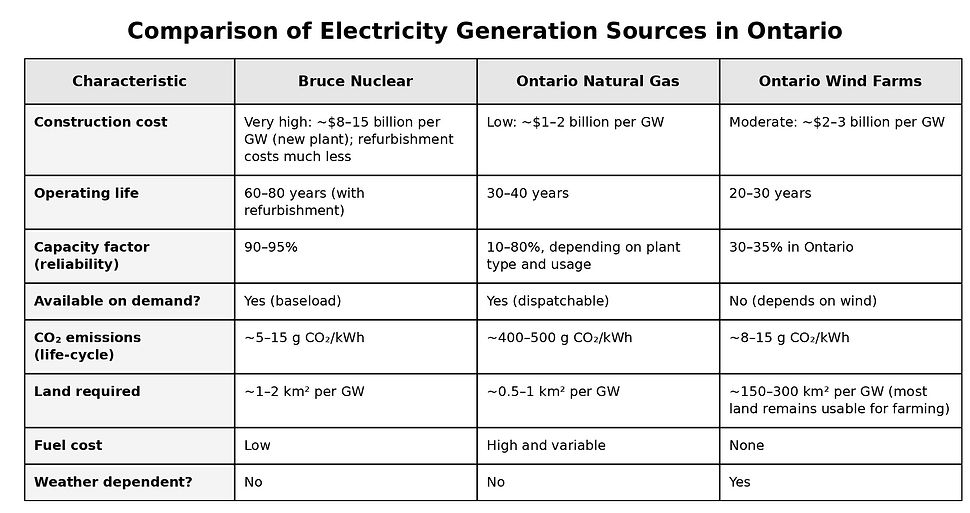
The debate over Ontario’s future energy mix ultimately reflects two competing visions. Advocates of nuclear expansion point to its high capacity factor (90–95%), long operating life of 60–80 years, low life-cycle emissions comparable to wind, and its status as dispatchable baseload power available regardless of weather. They argue that although construction costs are the highest of any generation source, these costs are amortized over decades of stable output, and that nuclear’s small land footprint and freedom from fuel-price volatility make it a dependable backbone for a grid facing doubling demand by 2050. This view has shaped the Ford government’s continued commitment to Bruce Nuclear’s expansion and to Small Modular Reactors at Darlington6.
Ecologically oriented organizations and renewable-energy advocates counter that wind and solar have become cheaper to build and faster to deploy than nuclear, without its unresolved waste-disposal burden or exposure to cost overruns and construction delays. They point to the plunging cost of renewable technology worldwide as evidence that decarbonization no longer requires accepting nuclear’s risks or price tag, and argue that intermittency — long cited as renewables’ central weakness — is increasingly manageable through battery storage systems such as BESS.
This pressure, combined with falling global renewable prices, is what drove the Ford government’s reversal from cancelling windfarm contracts to committing to 5,000–7,500 MW of new renewable capacity. The resulting Ontario policy is neither a pure nuclear strategy nor a renewables-led one, but a hybrid that keeps nuclear and gas as anchors while treating renewables and storage as a growing, increasingly indispensable complement.
Understanding why nuclear retains this anchor role, however, requires grappling with a contested premise underlying Ontario’s strategy: the claim that nuclear power is “clean” energy. Nuclear power’s central environmental strength lies in its carbon profile. Over its full lifecycle—mining uranium, building the plant, operating it, and decommissioning it—nuclear power emits roughly the same amount of carbon dioxide as wind power, and much less than natural gas or coal. While generating electricity, nuclear plants do not emit soot, sulfur dioxide, nitrogen oxides, or carbon dioxide, pollutants that contribute to smog, acid rain, and respiratory disease when released by fossil fuel plants. This is why many climate scientists and energy experts view nuclear power as an important low-carbon energy source.
Yet others remain concerned about its waste management, cost, and safety risks, and for good reason: nuclear is clean only in terms of greenhouse gas emissions, not in terms of its broader environmental footprint.
Spent nuclear fuel remains hazardous for thousands of years and requires secure long-term storage. Although the volume of waste is relatively small, managing it safely is a major and unresolved challenge. Serious accidents, while rare, illustrate the scale of risk involved. Three Mile Island (1979, USA) experienced a partial core meltdown; although no major radiation was released, it triggered widespread public alarm. Chernobyl (1986, USSR) remains the worst nuclear accident in history, with massive environmental and political consequences. Fukushima (2011, Japan) triggered reactor shutdowns and policy reversals in several countries. These events demonstrate that even infrequent accidents can carry severe environmental, health, and economic costs.
Uranium mining, if not properly managed, can also damage ecosystems and expose workers and nearby communities to environmental hazards. Nuclear plants further require large amounts of water for cooling, affecting local rivers and coastal ecosystems through water withdrawals and thermal pollution. This is not a hypothetical risk. In August 2026, extreme conditions aggravated by the climate emergency drained Europe’s waterways from the Netherlands to the Black Sea; for the first time in their history, Hungary and Romania were forced to shut down atomic reactors cooled by the Danube 7.
The uranium that fuels reactors is itself not problem-free. Uranium ore is naturally radioactive, and its radioactivity depends on the ore grade—the concentration of uranium it contains. Low-grade ore (e.g., 0.1% uranium) is only modestly more radioactive than ordinary rock, but high-grade ore (e.g., 10–20% uranium, found in parts of Canada) is far more radioactive and requires shielding and careful handling. Some ore from the Athabasca Basin contains over 20% uranium, making it among the richest uranium ore in the world; radiation levels can be high enough that miners must rely on remote handling and strict safety procedures.
Canada is a major source of this uranium, and the province’s own supply chain illustrates both the promise and the risks described above. Most uranium comes from the Athabasca Basin, a roughly 100,000-square-kilometre region in the Canadian Shield spanning northern Saskatchewan and Alberta, which currently supplies about 20% of the world’s uranium. Cameco Corporation, the world’s largest publicly traded uranium company, is based in Saskatoon, Saskatchewan, and operates a uranium refinery in Blind River and a uranium conversion facility in Port Hope 8.
Cameco is the exclusive fuel supplier to Bruce Power, which generates 30% of Ontario’s electricity through its nuclear plant—making this Canadian supply chain a direct link between the abstract environmental tradeoffs discussed above and Ontario’s own energy strategy.
The region’s uranium capacity is also poised to expand significantly. NexGen Energy’s Rook I Project, an underground mine and mill development in the uranium-rich southwestern Athabasca Basin, is currently the largest development-stage uranium project in Canada 9.
On March 5, 2026, the Canadian Nuclear Safety Commission approved NexGen’s Environmental Assessment and issued a Licence to Prepare Site and Construct for the wholly owned project.
Construction on the $2.2-billion project is now underway, and the company estimates that once operational, the mine could produce over 13,000 tonnes of uranium annually, representing roughly 20% of current global supply 10.
A project of this scale would substantially deepen the Athabasca Basin’s role in the global uranium market, while also intensifying the mining, waste, and environmental oversight challenges discussed above.
Federal Support for Nuclear Expansion
Ontario’s Conservative government was not alone in backing nuclear expansion, including the build-out of SMRs — the federal Liberal government supported it as well. Natural Resources Minister Jonathan Wilkinson announced on October 25, 2022, that Ottawa would direct $970 million toward a project being developed by Ontario Power Generation (OPG): a 300-MW SMR built adjacent to the existing 3,500-MW Darlington Nuclear Generating Station in Clarington. Wilkinson remained in the energy portfolio — as Minister of Energy and Natural Resources — under Prime Minister Carney until April 2026 11.
In the fall of 2025, Carney and Ford jointly announced $3 billion in funding to support Ontario’s purchase of four BWRX-300 SMR units from GE Vernova Hitachi Nuclear Energy, the Japanese–American reactor manufacturer. Of that total, Ottawa committed $2 billion through the Canada Growth Fund, with Ontario covering the remainder. The funding is earmarked for four SMRs at the Darlington New Nuclear Project (DNNP), and in their joint announcement, Carney and Ford noted that Canada would become the first G7 country to build a grid-connected SMR 12.
Meanwhile, Ontario’s existing large-scale nuclear plants at Bruce, Darlington, and Pickering are undergoing refurbishments that have proven both costly and time-consuming. New Brunswick Power’s Point Lepreau Nuclear Generating Station went through a comparable process years earlier, and the experience gives some sense of what can go wrong: its 2009 refurbishment ran $1 billion over budget and took 4.5 years to complete — three years behind schedule. The delays stemmed largely from faulty tube installations, an inexperienced contractor, and disputes between the utility and Atomic Energy of Canada Limited (AECL), the contractor responsible for the work. The project came to be regarded as one of North America’s worst-performing nuclear refurbishments 13.
Bruce Power’s recent work on Unit 3 illustrates just how involved a nuclear refurbishment can be. Crews cut an opening into the roof of the operating station, lifted out eight steam generators — each weighing roughly 100 metric tons (about 110 US tons) — and lowered replacements into the same opening. The unit returned to service on June 8, 2026 (Weekly Voice).
Unit 3 is a CANDU reactor on the shore of Lake Huron that entered commercial service in the late 1970s. Its refurbishment began in March 2023 as part of a broader effort expected to add 30 to 35 years to the reactor’s operating life 14.
The replacement steam generators themselves were manufactured by BWXT in Cambridge nearly two decades ago and sat in storage at the Bruce site until they were needed (Nuclear Engineering International). Lifting them into place fell to Mammoet’s PTC-35, a ring crane standing more than 100 metres tall 15.
Ontario’s Independent Electricity System Operator set a fixed cost of CAD $1.9 billion for the Unit 3 refurbishment when it approved the project in 2022. The Ontario Clean Air Alliance, an advocacy group, has since argued that the government has not released the original budget or final cost figures needed to independently verify that number 16.
Canada’s own experience with the waste question illustrates just how demanding this challenge is, both technically and financially. In November 2024, the Nuclear Waste Management Organization (NWMO) selected the Wabigoon Lake Ojibway Nation and the Township of Ignace, roughly 250 kilometres northwest of Thunder Bay, as the host community for the country’s first deep geological repository 17.
The proposed facility would bury close to 5.9 million bundles of used nuclear fuel between 650 and 800 metres underground, within a footprint spanning roughly two by three kilometres 8.
The scale of this undertaking is matched by its cost. Initial construction alone is projected at a minimum of $4.5 billion over the coming decade, while the NWMO estimates the facility’s full lifetime cost—spanning an anticipated 175 years of operation—at roughly CA$26 billion. These costs will be recovered through fees charged to nuclear utilities, meaning they are ultimately embedded in the electricity rates Ontario consumers pay. The project is currently working through regulatory review 19.
Experience elsewhere suggests these projections may prove optimistic. Finland’s Onkalo facility, the world’s first operational deep geological repository, was originally budgeted at €503 million in 2003 but had climbed to roughly double that figure by 2023 20.
This pattern of substantial cost overruns is common to deep geological repository projects internationally, underscoring that the long-term burden of nuclear waste is not simply a matter of engineering, but one of sustained public expense that complicates any simple claim that nuclear power is “clean.”
Ontario’s experience, however, is only one chapter in a much larger global story; nuclear power today operates at vastly different scales across dozens of countries, each with its own mix of reactors, ambitions, and constraints.


Source: Statista (statista.com)21
Nuclear power’s global story begins in the 1940s, when the earliest reactors emerged from the Manhattan Project’s effort to produce plutonium for nuclear weapons. Chicago Pile-1, built in 1942, was the first reactor of any kind. Electricity generation followed a few years later: the Experimental Breeder Reactor I, located in the high desert of eastern Idaho near Arco, became the first reactor to produce electricity on December 20, 1951. The Soviet Union’s Obninsk plant followed in 1954, becoming the first nuclear facility to supply electricity to a public grid, and the United Kingdom’s Calder Hall opened in 1956 as the world’s first commercial-scale nuclear power station.
From these origins, nuclear power has since scaled unevenly across the globe, with a small number of countries now accounting for most of the world’s operating capacity. The United States remains the largest operator, running 94 commercial reactors across 54 power plants for a combined net capacity of roughly 97 gigawatts; nuclear power supplies about 18–19% of the country’s electricity, and the U.S. alone generates close to 30% of the world’s nuclear-generated electricity.
China ranks second in reactor count, with about 58.7 gigawatts of operational capacity across 60 reactors as of May 2026, though nuclear still supplies only 4.5–5% of the country’s electricity generation. China’s ambitions, however, extend well beyond its current fleet: it has 36 additional reactors under construction, representing nearly half of all nuclear capacity being built worldwide, and by the end of 2025 its combined operating, under-construction, and approved capacity exceeded 120 gigawatts, the highest total of any country 22.
China’s approach pairs this nuclear expansion with parallel investment in wind, solar, hydro, and storage, aimed at meeting long-term electricity demand while reducing reliance on coal. If current construction and approval trends continue, China is expected to overtake the United States in total installed nuclear capacity sometime in the 2030s.
France offers a different model altogether. With 57 reactors, it ranks third in the world by reactor count, but it is the global leader by share of electricity generated: nuclear power supplies roughly 65–70% of France’s total electricity, by far the highest proportion of any major economy. This concentration reflects a deliberate national strategy launched in the 1970s, when France moved to build out its nuclear fleet rapidly in response to the oil crisis, aiming for energy independence rather than incremental diversification. The result is a grid that, unlike those of the U.S. or China, relies on nuclear as its primary rather than supplementary power source.
Russia, the birthplace of commercial nuclear power through the Obninsk plant, remains a significant operator today, running 37 commercial reactors with a combined capacity of about 30 gigawatts, including several advanced fast-neutron reactors at its Beloyarsk plant.
Nuclear Power in Ontario
Set against this global backdrop, Canada’s fleet of 17 reactors is comparatively modest, and Ontario accounts for nearly all of it. Nuclear energy supplies roughly half of Ontario’s total electricity, generated across three stations: Bruce, Darlington, and Pickering. Each has its own story of construction and renewal, and together they illustrate both the promise and the cost of keeping a nuclear fleet running for half a century and beyond.
The oldest and largest of the three is the Bruce Nuclear Generating Station, sited on the eastern shore of Lake Huron near Tiverton. Bruce was Canada’s first nuclear station, and today it remains the largest operating nuclear facility in the world by installed capacity. Bruce A’s construction began in 1970. Unit 1 entered service in September 1977, and Units 2 through 4 followed over the next two years. A second phase, Bruce B, began construction in the mid-1970s and brought Units 5 through 8 online between 1984 and 1987, rounding out a fleet of eight CANDU reactors that all still operate today. Together they produce about 6.6 gigawatts of power, enough to supply roughly 30 percent of Ontario’s electricity and, by extension, an estimated 6 million homes. Bruce was originally built and run by Ontario Hydro, but since 2001 it has been operated by Bruce Power under a long-term lease. Several of its reactors have since undergone major refurbishment, work intended to keep them generating power into the 2060s.
Southeast of Bruce, in the municipality of Clarington, lies the Darlington Nuclear Generating Station, operated by Ontario Power Generation. Darlington’s four CANDU reactors were built between 1989 and 1993 at a cost of about $14.4 billion in 1993 dollars. That sum would translate to roughly $27.6 billion in today’s currency. Decades later, the station underwent a mid-life refurbishment of its existing reactors, completed at a cost of about $12.8 billion and, reported as finished under budget 23.
Darlington’s significance extends beyond its four original units, too: the site is now home to North America’s first grid-scale Small Modular Reactor project, positioning it at the leading edge of Ontario’s next generation of nuclear development 24.
The third station, Pickering, lies just 35 kilometres from downtown Toronto and holds the distinction of being one of the oldest nuclear stations in the world, having entered service in 1982. Of its original eight CANDU reactors, six remain in operation today, together producing about 2.1 gigawatts. Pickering’s future, however, is now in transition. Its operating licence was set to expire in August 2028, and OPG has applied to renew it for a further ten years, coupled with a request to refurbish Units 5 through 8 at an estimated cost of $27 billion. The station’s two oldest reactors, Units 1 and 4, were already permanently shut down at the end of 2024, and the four remaining units are scheduled to follow at the end of 2026, when they will be taken offline and prepared for a multiyear refurbishment. If that work proceeds as planned, those units are expected to return to service by the mid-2030s.
Taken together, Bruce, Darlington, and Pickering represent a province that built much of its nuclear fleet in a single concentrated era, spanning the 1970s through the early 1990s. Ontario now faces the parallel challenge of refurbishing that aging infrastructure while also, at Darlington, beginning to build something new.
Beyond the ongoing refurbishments, Ontario is also gearing up for major new nuclear builds, including OPG’s proposed station in Port Hope and Bruce Power’s Bruce C project. The Port Hope station, planned for the Wesleyville site, could reach up to 10 GW of nuclear capacity, enough to supply an estimated 10 million homes, though the project will now go through a multi-year federal impact assessment before construction can proceed.
Nuclear Construction Trends, Past and Present
When Bruce A Unit 1 entered commercial operation in September 1977, roughly 200 nuclear power reactors were already running worldwide — about half of all the reactors that would eventually be online by 1990. The late 1970s marked the peak of the largest nuclear construction boom in history. Between 1970 and 1990, the global reactor fleet grew from 84 units to more than 400, as country after country expanded nuclear generation in the wake of the 1973 oil crisis.
That boom, in the Western Hemisphere at least, has largely faded. Today the United Kingdom stands nearly alone among Western nations in building large reactors, with two European Pressurized Reactor (EPR) units under construction at Hinkley Point C. The United States, France, and Canada currently have no large conventional reactors under construction, having shifted their attention instead toward Small Modular Reactors (SMRs).
Globally, the picture looks different. About 80 reactors are under construction across 15 countries, with roughly 120 more in the planning stages — and the great majority of that activity is happening in Asia 25.
China stands at the center of this new wave. The country currently has 36 reactors under construction, representing 44.1 gigawatt-electric (GWe) of capacity, a measure of electrical output rather than thermal power. That pace of build-out has not been matched since the United States and France constructed their own fleets through the 1970s and ’80s. Over just the past 15 years, China has added more nuclear capacity than the rest of the world combined.
The Shift to Small Modular Reactors
That decades-long pause in large nuclear construction across the Western Hemisphere has given way to a different kind of experiment: Small Modular Reactors (SMRs). Nowhere is this shift more consequential than in Canada, which has taken on the risks and the costs of deploying first-of-a-kind SMR technology at commercial scale.
While Ontario’s other planned nuclear projects, at Port Hope and Bruce C, remain large-scale conventional builds, the same Darlington site already home to Ontario’s aging fleet is now hosting a very different kind of nuclear project. North America’s first grid-scale SMR is now under construction at the Darlington New Nuclear Project (DNNP) in Clarington, Ontario 26.
Ontario Power Generation (OPG) applied to the Canadian Nuclear Safety Commission for a licence to construct one General Electric Hitachi BWRX-300 reactor at the Darlington site in October 2022, and the Commission issued that construction licence on April 4, 2025, valid until March 31, 2035. The following month, the Province of Ontario approved a CAD 20.9 billion budget and authorized the start of construction for the first of four planned SMRs at the site 27.
The Darlington project represents Ontario’s first new nuclear build in more than 30 years. The utility is ultimately planning for four SMRs at Darlington, next to the existing Darlington nuclear power station, with the goal of generating up to 4,800 MW of electricity for the Ontario grid. The first unit is scheduled to come online by the end of 2030, expected to supply roughly 300 megawatts — enough electricity for approximately 300,000 homes.
Small Modular Reactors are a distinct class of nuclear technology: physically compact fission reactors, generally producing 300 MW(e) or less, designed to be prefabricated in factories and assembled on-site — an approach intended to shorten construction timelines, reduce upfront costs, and make nuclear power viable in more remote locations.
The reactor chosen for Darlington, the GE Vernova Hitachi BWRX-300, is a 300 MWe small modular reactor featuring natural circulation cooling and passive safety systems, built on the licensed ESBWR design and GNF2 fuel. The “X” in its name marks it as GE Hitachi’s tenth-generation boiling water reactor design28.
Construction Progress at Darlington
The project has moved steadily to physical construction. By early 2026, OPG had completed excavation work on the shafts supporting construction of the site’s first unit that reached 35 metres below grade29.
In May 2026, in that excavated shaft, workers lowered the reactor building’s foundation, a prefabricated unit weighing close to 953 tonnes and measuring 37 metres in diameter. Notably, it was fabricated, welded, and assembled off-site as a single module before being lifted into the shaft by one of the world’s largest crawler cranes, making it the first time in Canada that a reactor building foundation has been assembled modularly30.
The build itself rests on a delivery alliance linking OPG with major engineering and construction partners. Candu Energy, an AtkinsRéalis company, was awarded a CAD 450 million execution contract by OPG for the first of the four planned SMR units, while Aecon has carried out major site preparation and construction work at Darlington31.
That partnership structure has helped build a substantial domestic supply chain. More than 80 Ontario-based companies, including northern and rural suppliers, had already signed agreements with OPG and its partners to deliver the project, and by mid-2026 the supply chain had grown to more than 100 Canadian companies in total, with 16 additional Ontario firms and six from Quebec and Alberta joining32.
Ontario has positioned this first-mover status as an export opportunity, promoting the province’s SMR supply chain to European utilities in Poland and Finland that are pursuing their own SMR programs.
Ontario’s Energy Cost Comparison
According to Ontario Power Generation (OPG), the cost of building the Darlington New Nuclear Project, the first small modular reactor (SMR) fleet in a G7 country, is now several times higher than GE Hitachi Nuclear Energy, the reactor’s Wilmington, N.C.-based designer, originally projected. Early in development, GE Hitachi had set a target cost of US$700 million per reactor, or US$2.25 million per megawatt, a level meant to make the BWRX-300 competitive with natural gas33.
OPG has stated that the project will be financed not by government but by the utility itself, drawn from cash on hand, cash flow from its existing generating stations, and debt. Those costs will ultimately be recovered from Ontario ratepayers through their electricity bills. OPG estimates the average cost of power from the four planned reactors at 14.9 cents per kilowatt-hour, a projection that depends on the federal government delivering the investment tax credits it has promised.
By comparison, Ontario’s Independent Electricity System Operator (IESO) modelled an alternative path: building 5,600 to 8,900 megawatts of wind and solar capacity backed by battery storage. Because wind and solar are intermittent, the IESO noted, this approach would require substantially more installed capacity and new transmission infrastructure to match the reliability of nuclear. It estimated the cost of this renewable alternative at 13.5 to 18.4 cents per kilowatt-hour — and concluded that building the BWRX-300 remains the lower-risk option.
Independent analysts, however, have raised concerns about whether OPG’s costs undermine the case for SMRs more broadly. Clean Prosperity, a Canadian climate policy think tank, projected that a final cost near $3 billion — or $10.16 million per megawatt — would be needed to spark rapid SMR adoption elsewhere. This figure represents a forward-looking target for future SMR fleets, not a benchmark already achieved. By comparison, France and the U.S. historically built large conventional reactors at $12.5 million and $17.5 million per megawatt, respectively — costs that are themselves well above Clean Prosperity’s SMR target, illustrating how far even established nuclear construction costs remain from the threshold needed to make SMRs competitive. The International Energy Agency has gone further, stating in a January 2025 report that SMR costs must fall to US$4.5 million per megawatt by 2040 to achieve rapid uptake — a target further still from OPG’s current trajectory 34.
Reporting by the Globe and Mail put OPG’s official price tag for the first reactor at $7.7 billion — equivalent to roughly $25.7 million per megawatt on a 300 MW unit, well above the costs France and the U.S. paid for large-scale nuclear construction, let alone the threshold Clean Prosperity and the IEA describe as necessary for rapid SMR adoption elsewhere. For comparison, a recently completed 377-megawatt natural gas plant in Saskatchewan cost $825 million. Ed Lyman of the Union of Concerned Scientists called the figure unsurprising given what’s known about the poor economics of small nuclear reactors35.
The Darlington project, and its final price tag, is being closely watched by utilities worldwide, as the BWRX-300 design is also under consideration for projects in the U.S., U.K., Poland, and Estonia, among others.

Source: Energy Futures Ontario and Clean Air Alliance 36.
The infographic’s 3.1¢/kWh Energy Efficiency figure is specifically tied to the IESO 2025–2027 Demand Side Management Program Plan, page 7. The solar, wind, and nuclear LCOE figures are drawn from the IESO Annual Planning Outlook and the Energy Futures Group’s LCOE calculations (Table 3), which assume a 30% investment tax credit.
(Figures are drawn from two sources using different currencies: Energy Futures Group (EFG), a U.S.-based consulting firm, reports costs in U.S. dollars, while the Ontario Clean Air Alliance (OCAA) reports in Canadian dollars. To compare across the two, U.S.-dollar figures can be converted to Canadian dollars by multiplying by 1.39) 37.
This IESO comparison, however, is not the only cost estimate in circulation — a separate levelized-cost analysis paints a starkly different picture.
The chart compares the levelized cost of electricity (LCOE) — the average cost of producing one megawatt-hour (MWh) of electricity over a project’s lifetime — for several technologies. It assumes projects are built for 2030 and receive a 30% investment tax credit.
The comparison shows that renewable energy is projected to be much less expensive than new nuclear power. Utility-scale solar has the lowest estimated cost at about US$41/MWh, followed by onshore wind at US$27–43/MWh. Offshore wind is more expensive than solar and onshore wind, but still relatively economical at US$86–93/MWh. In contrast, new large conventional nuclear power plants are estimated to produce electricity at US$206–226/MWh, making them roughly five times more expensive than solar and about five to eight times more expensive than onshore wind. First-of-a-kind small modular reactors (SMRs) are projected to be even more expensive, at US$211–232/MWh, while later SMR units, after experience lowers costs, are expected to fall to US$159–174/MWh. Even these later SMRs, however, remain substantially more expensive than wind and solar.
Overall, the chart illustrates the claim that, under the stated assumptions, renewable electricity sources — especially solar and onshore wind — can generate power at far lower cost than new nuclear plants or SMRs. Offshore wind occupies a middle position, costing more than solar and onshore wind but considerably less than new nuclear technologies.
This conclusion is echoed by the Ontario Clean Air Alliance (OCAA), a Toronto-based advocacy group whose research arm, Ontario Clean Air Alliance Research Inc., produces the studies and reports underpinning its advocacy work. OCAA states that power from new nuclear reactors, including Darlington, will cost up to eight times more than power from onshore wind turbines.
OCAA first made its name leading the successful campaign to phase out Ontario’s coal-fired power plants, and is now working toward a zero-carbon electricity grid by 2035, primarily through energy conservation and efficiency, cost-effective made-in-Ontario green energy, and energy cooperation with neighbouring jurisdictions. The group opposes nuclear power expansion, arguing that new nuclear reactors are the most expensive way to produce electricity — two to eight times costlier than onshore wind and solar. It bases this claim on sources including Lazard, Ontario’s grid operator (IESO), and the Energy Futures Group 38.
One vocal critic of the Ontario government’s plans to expand the nuclear program is Mark Winfield, a professor of Environmental and Urban Change at York University and a frequent expert contributor to OCAA. In a February 2025 opinion piece, Winfield argued that any sound economic strategy for Ontario should prioritize controlling energy costs over expanding energy production.
He noted that the Pickering B and Darlington new-build projects mark only the beginning of the province’s nuclear expansion plans. Additional projects proposed for Wesleyville and the Bruce nuclear site, he wrote, could push total capital expenditures past $300 billion. Winfield pointed out that the Ford government has not disclosed what its nuclear expansion program will ultimately cost or how it would be financed. He highlighted a proposed 10,000-megawatt facility at Wesleyville, between Cobourg and Kingston, floated just before the election call, which could alone break the $200-billion mark in capital costs. A second proposed facility — a 4,800-MW plant at the Bruce nuclear site — would add roughly $100 billion more on the same basis.
Ultimately, the debate over nuclear costs in Ontario comes down to a fundamental disagreement over framing: whether nuclear’s high upfront capital costs and long construction timelines are outweighed by its low emissions, reliability, and long operating life — or whether, as critics like OCAA and Winfield contend, cheaper and faster-to-deploy renewables make nuclear expansion an unnecessary economic gamble for ratepayers 39.
These competing cost estimates—whether measured in cents per kilowatt-hour or dollars per megawatt—ultimately trace back to the same underlying reality: nuclear power’s economics, like its risks and benefits, are inseparable from the physical process happening inside the reactor core itself.
The Physics of Nuclear Fission in CANDU Reactors
To better understand the issues surrounding nuclear energy, whether generated by traditional large-scale plants or by planned Small Modular Reactors (SMRs), it is necessary to first examine the physical processes occurring within a reactor core. This report traces the mechanism by which uranium fission is initiated and sustained, using the Bruce Nuclear Generating Station, a CANDU-type facility, as a reference case.
The Fission Process
Within a reactor such as Bruce, the process begins at the atomic level. Natural uranium consists predominantly of Uranium-238, with only a small proportion of the fissile isotope Uranium-235, fissile meaning that it is capable of splitting upon absorbing a neutron. When a free neutron strikes and is absorbed by a Uranium-235 nucleus, the nucleus is transformed into Uranium-236, a highly excited and unstable configuration that persists for only a fraction of a second before disintegrating. As it breaks apart, the nucleus releases two smaller radioactive fission products, two to three new neutrons, and a substantial quantity of heat energy. These newly liberated neutrons then go on to strike further Uranium-235 nuclei elsewhere in the fuel, propagating the reaction outward in a self-sustaining sequence. When this chain reaction is properly regulated, it settles into a steady and continuous source of heat, suitable for generating electricity.
Initiating the Reaction in a CANDU Reactor
A CANDU reactor such as Bruce is fuelled with natural uranium dioxide, in which Uranium-235 makes up only about 0.7 percent of the material, too little to sustain a reaction on its own without assistance in getting started. For this reason, the reactor is brought to criticality through a dedicated startup procedure: a small neutron source is inserted into the core, while adjuster rods and control rods are manipulated to establish the first self-sustaining chain reaction. This is made possible in part by the reactor’s use of heavy water, or D₂O, as a moderator. Heavy water slows neutrons with particular efficiency, a property that allows natural, unenriched uranium to be used as fuel in the first place. Once the reaction is underway, control rods and liquid neutron absorbers work continuously to regulate the neutron supply, holding the reaction at the desired power level.
The Role of the Startup Neutron Source
The small neutron source used to begin this process is, in essence, a device that emits a low but steady stream of neutrons. It plays no role in powering the reactor; its sole function is to supply the initial neutrons needed to set the controlled chain reaction in motion. The most commonly used sources for this purpose are Americium–Beryllium (Am-Be) devices, though Californium-252 (Cf-252) is also employed.
During startup, this source provides the very first neutrons to enter the fuel. As Uranium-235 nuclei begin to fission in response, each releases two to three neutrons of its own, and within a short span of time the reactor’s own fission process comes to generate vastly more neutrons than the original startup source ever supplied. The source’s contribution therefore becomes, for all practical purposes, insignificant almost as soon as the chain reaction takes hold. In this way, the chain reaction is started in a manner that is both predictable and fully controlled.
The Fuel Bundle During Operation
It is worth noting that the onset of fission does not compromise the physical integrity of the fuel itself. The fuel bundle remains intact throughout normal operation, and only a small fraction of the uranium atoms within the fuel pellets undergo fission on any given day. The pellets and their surrounding metal cladding are engineered to withstand years of continuous reactor operation, containing the fission process safely within their structure even as it proceeds.
Fuel Bundle Design and Lifecycle in a CANDU Reactor

The accompanying diagram illustrates the structure of a CANDU reactor and the pathway its fuel follows over the course of operation40. At the core of this design is the fuel itself, which consists of small ceramic pellets of uranium dioxide (UO₂), within which the fission process described earlier actually takes place. Although these pellets reach considerable temperatures during operation, typically several hundred degrees Celsius, and over 1,000°C at their centre, they remain solid throughout, as uranium dioxide does not melt until approximately 2,800°C.
Each pellet is sealed within a thin tube of zirconium alloy, known as cladding, which together with the pellets forms the fuel bundle. This cladding serves several essential functions: it retains the radioactive fission products generated during fission, prevents direct contact between the fuel and the heavy-water coolant, and permits heat to be transferred efficiently from the fuel to the coolant surrounding it. Over the course of years in service, the bundle undergoes gradual change, as the cladding accumulates radiation damage and minor deformation, yet it is engineered specifically to remain intact under normal operating conditions throughout its service life.
These fuel bundles are loaded into the reactor vessel, known as the calandria, and are continually replaced while the reactor remains in operation. After a period of roughly twelve to eighteen months, a given bundle’s energy output declines to the point where it is no longer efficient to continue using it, at which point it is removed from the reactor and replaced with fresh fuel. Although spent, the removed bundle remains physically recognizable in form. It is, however, highly radioactive and continues to generate heat through the ongoing decay of its fission products. For this reason, it is first transferred to a water-filled spent fuel pool, where it is cooled and shielded, before eventually being moved to dry storage for longer-term management.
Understanding this sequence, from the initial absorption of a neutron, through the establishment of a self-sustaining chain reaction, to the sustained integrity of the fuel itself, provides the necessary technical foundation for evaluating broader questions of nuclear safety, control, and viability, whether in the context of established facilities like Bruce or emerging SMR designs.
Having looked at how fuel bundles are engineered, loaded, and cycled through a CANDU core, it makes sense to turn to a reactor family that does away with solid fuel bundles altogether: Molten Salt Reactors.
The Rise of Molten Salt Power
An important class of Small Modular Reactors is the Molten Salt Reactors (MSRs). It is a newer concept and still under development. It has significant advantages over BWRs, which are currently entering the construction phase. The basic difference is that MSRs do not use water to cool the reactor, as BWRs do. Instead, they use molten salt, which boils at significantly higher temperatures than water and thus provides a wide safety margin for reactors functioning at lower temperatures. This allows for simplification of the technical design, although it introduces its own special safety features to counteract the highly corrosive nature of molten salt. Several designs are under development in the US, Europe, and other countries, and China already has a functioning MSR 41.
In recent years, thorium reactors have gained increasing attention as a potential solution to the compounding crises facing the global energy sector: climate change, intensifying geopolitical conflicts, and the AI boom, to name a few critical examples 42.
US Heavily Involved in MSRs
Molten salt reactors are nothing new. They have been around since the 1960s and date back to the days of the Molten Salt Reactor Experiment at Oak Ridge National Laboratory. After a hiatus of several decades, the concept met with renewed interest, and the US now conducts extensive research on molten salt reactors.
The U.S. Department of Energy (DOE) funds initiatives such as the Advanced Reactor Demonstration Program to test next-generation reactor fuels, improve safety, and identify corrosion-resistant materials. This research is led by several major national laboratories and private companies, including Idaho National Laboratory (INL), which hosts the Molten Salt Thermophysical Examination Capability (MSTEC) and has produced full-scale batches of enriched fuel salt for the upcoming Molten Chloride Reactor Experiment (MCRE) 43.
Oak Ridge National Laboratory (ORNL), the birthplace of MSRs in the mid-20th century, continuously tests new methods to track chemical changes and simulate reactor cores44.
Private Sector Development
Private developers are also advancing molten salt technology. TerraPower, backed by Bill Gates, has been researching molten chloride fast reactors alongside testing facilities at various national laboratory sites 45.
The company has partnered with Southern Company, a leading U.S. energy company, to develop the Molten Chloride Fast Reactor (MCFR), which uses liquid chloride salts as both coolant and fuel. In this design, the salts flow directly through the reactor core, allowing fission to heat them in place rather than relying on a separate coolant medium 46.
Fuel Breakthrough Opens Path to Maritime Nuclear Power
Idaho National Laboratory announced in late 2025 that it had successfully manufactured fuel for the Molten Chloride Reactor Experiment (MCRE) for the first time, a milestone described by MCRE senior technical advisor Don Wood as opening the door to using molten salt reactors aboard ships. He noted that the technology could give vessels a compact, low-maintenance nuclear power source that cuts emissions and supports long, uninterrupted voyages without refueling 47.
The achievement, reported in December 2025, represents progress toward commercial maritime deployment of fast molten salt reactor technology 48.
The MCRE program is a joint effort between Southern Company, TerraPower, and CORE POWER, working toward the full-scale commercial MCFR design described above.
How the MCFR Works
The commercial MCFR design targets an electrical output of up to 1,200 megawatts. Once the fission-heated fuel salt leaves the core, it passes through a heat exchanger into a separate loop of coolant salt, which can be tapped for generating electricity, supplying industrial process heat, or storing thermal energy.
Because the reactor runs at much higher temperatures than conventional designs, it converts heat to electricity more efficiently. Traditional light water reactors operate around 300°C under pressurized conditions and typically convert only 30 to 33% of their heat into electricity. The MCFR, by contrast, runs above 600°C, which alone improves on that baseline efficiency. Molten salt reactor designs, operating in the 600 to 700°C range, can push electrical conversion efficiency up toward 40 to 50% while also generating high-temperature heat usable for industrial processes.
The design also produces less nuclear waste overall, and the MCFR has the added potential to consume spent fuel from other reactor types as part of its fuel cycle.
Concluding Remarks
Taken as a whole, this chapter has traced nuclear power from its physical foundations in the reactor core to its economic and political standing in Ontario, and outward to the global picture of reactor construction and next-generation technologies such as SMRs and molten salt designs. What emerges is a technology caught between real strengths — a low-carbon footprint, high reliability, and long operating life — and real costs, whether measured in dollars, construction delays, unresolved waste storage, or the water and land demands that complicate any simple claim that nuclear power is “clean.” Ontario’s own experience, from Bruce and Darlington to the fledgling Darlington New Nuclear Project, illustrates both sides of that tension clearly.
This chapter has focused on nuclear energy largely on its own terms, with renewables entering the discussion mainly as a point of comparison — in cost tables, in competing IESO and OCAA estimates, and in the broader debate over how Ontario should meet its doubling electricity demand. A fuller account of that alternative path is reserved for a future chapter, which will examine renewable energy — solar, wind, hydro, and storage — specifically in the context of climate change: its accelerating deployment worldwide, the technical and economic case for it, and the role it is likely to play alongside, or in place of, nuclear power in Ontario’s and the world’s energy future.
Chapter Summary
This chapter examines the suitability of nuclear power as a long-term energy strategy for Ontario, and by extension Canada, framed as a discussion between advocates of large-scale nuclear expansion and advocates of renewable energy as a cheaper, more practical alternative. The analysis is situated within the policy context of the current Conservative provincial government under Premier Doug Ford. Notably, the government’s position marks a considerable reversal from its earlier stance: during its first months in office in 2018, Ford’s administration actively dismantled renewable energy projects, particularly wind farms already in the planning stage. Although he continues to maintain that nuclear energy is the only viable long-term solution, he now concedes that renewables could play a secondary role.
The chapter situates this policy shift against a broader consensus that electricity demand in Ontario is expected to double in the coming decades, driven by population increase, economic expansion, the electrification of transportation, and the rapidly rising energy consumption of data centers supporting AI-driven industries and cryptocurrency operations—demand that has already surpassed that of heavy industry. This Ontario-specific debate is placed against the backdrop of parallel developments worldwide in both nuclear and renewable energy, from the United States and France’s mature nuclear fleets to China’s rapid, simultaneous buildout of nuclear, wind, and solar capacity.
A review of the existing literature indicates that nuclear energy remains the most expensive electricity source when compared to natural gas and renewable alternatives, particularly hydroelectric power. This economic disadvantage is considered alongside the technical and environmental challenges associated with nuclear power, as illustrated by the operating history of Ontario’s three nuclear facilities. By contrast, the chapter highlights the Melancthon Township wind farm, one of Ontario’s earliest and largest, as a case of stable, largely trouble-free operation over two decades.
Particular attention is given to Ontario’s ambitions to expand its nuclear sector through Small Modular Reactors (SMRs), an initiative through which the province seeks to position itself as a global leader, despite the fact that no SMRs have yet been constructed anywhere in the Western Hemisphere. The chapter notes that while China and Russia have already deployed SMRs, their designs differ from those proposed for the Canadian context. In contrast, the chapter documents the accelerating global deployment of wind and solar power, with China leading the field.
The chapter concludes that renewable energy sources are an indispensable, and frequently preferable, component of future energy planning, offering a more cost-effective and practically achievable pathway than new nuclear development, which remains comparatively expensive, difficult to construct and maintain. This conclusion, however, is offered as a weighing of current evidence rather than a final verdict: substantial research is underway worldwide in both fields, and future developments could shift the balance further. Of particular note is ongoing work on molten salt reactors (MSRs), which may prove better suited than boiling water reactors—including the BWRs Ontario has chosen for both its large-scale plants and its SMR fleet—to complement, rather than compete with, a renewables-led grid. MSR designs promise the potential for cheaper, simpler construction and the flexibility to supply power precisely when wind and solar output falls short of fluctuating demand, a role distinct from the baseload function nuclear power has traditionally been expected to play.
References:
1. Krugman, P. (2026, February 16). Turning our back on clean energy. Substack. https://paulkrugman.substack.com/p/turning-our-back-on-clean-energy
2. Independent Electricity System Operator. (2022, December 15). Pathways to Decarbonization.
3. Ontario Ministry of Energy and Mines. (2025, June). Energy for Generations: Ontario’s integrated plan to power the strongest economy in the G7 (see Nuclear section, p. 9). https://www.ontario.ca/page/energy-generations
4.Crawley, M. (2024, August 19). Doug Ford shifts direction on wind power in Ontario. CBC News (republished by Radio Canada International). https://ici.radio-canada.ca/rci/en/news/2097832/doug-ford-shifts-direction-on-wind-power-in-ontario
5. Energy for Generations. Ontario’s integrated plan to power the strongest economy in the G7. June 2025.
6. Ontario Ministry of Energy. (2023, July). Powering Ontario’s growth: Ontario’s plan for a clean energy future. Government of Ontario. https://www.ontario.ca/page/powering-ontarios-growth
7. Cole, D. (2026, August 1). Lost income, energy fears and a woolly mammoth: What Europe’s dried-up rivers have yielded. The Guardian. https://www.theguardian.com/environment/2026/aug/01/eastern-europe-dried-up-rivers-tourism-energy-mammoth
8. Cameco Corporation. (n.d.). Home page. https://www.cameco.com/
9. NexGen Energy. (n.d.). Rook I Project. https://www.nexgenenergy.ca/rook-1-project/
10. Warren, J. (2026, August 13). NexGen breaks ground on major uranium mine in northern Sask: Construction underway on $2.2B Rook I project in Athabasca Basin. CBC News. https://www.cbc.ca/news/canada/saskatchewan/nexgen-breaks-ground-on-massive-uranium-mine-in-northern-sask-9.7306078
11. Proctor, D. (2022, October 26). Canada bank group pledges millions toward nuclear power project. POWER Magazine. https://www.powermag.com/canada-bank-group-pledges-millions-toward-nuclear-power-project/
12. Global News. (2025, October 23). ‘Energy powerhouse’: Carney, Ford invest $3B on mini nuclear power plant in Ontario [Video]. https://globalnews.ca/video/11491321/energy-powerhouse-carney-ford-invest-3b-on-mini-nuclear-power-plant-in-ontario/
13. Jones, R. (2017, July 7). NB Power seeks to settle lawsuits over Point Lepreau refurbishment cost overruns. CBC News;
McClearn, M. (2024, July 29). Point Lepreau station is among North America’s worst-performing nuclear power plants. Can NB Power turn it around? The Globe and Mail. https://www.theglobeandmail.com/business/article-point-lepreau-station-is-among-north-americas-worst-performing-nuclear/
14. Nuclear Engineering International. (2025, February 26). Bruce Power completes steam generator replacement project at unit 3. https://www.neimagazine.com/news/bruce-power-completes-steam-generator-replacement-project-at-unit-3/
15. Reyes, L. (2026, June 27). Canada just cut a hole in the roof of a working nuclear reactor, hauled out eight steam generators weighing 100 tons each, and lowered new ones into the same hole, bringing the reactor back online seven months early to run another 35 years. https://www.autonocion.com/us/canada-hole-nuclear-reactor-eight-100-tons/
16. Ontario Clean Air Alliance. (2026, July 8). Bruce Nuclear refurbishment: What is the Ontario government not telling us? https://www.cleanairalliance.org/bruce-nuclear-refurb/
17. Nuclear Waste Management Organization. (2024, November 28). The Nuclear Waste Management Organization selects site for Canada’s deep geological repository. https://www.nwmo.ca/news/the-nuclear-waste-management-organization-selects-site-for-canadas-deep-geological-repository
18. Nuclear Waste Management Organization. (n.d.). Canada’s deep geological repository for used nuclear fuel. https://www.nwmo.ca/canadas-plan/canadas-deep-geological-repository
19. Privy Council Office, Major Projects Office. (2026, June 24). Deep Geological Repository (Nuclear Waste Management Organization project). Government of Canada. https://www.canada.ca/en/privy-council/major-projects-office/projects/national/geo.html
20. Vellone, J. A. D., Freitag, S., & Blackstein, R. (2025, January 10). Canada’s first deep geological repository site is selected. Borden Ladner Gervais LLP. https://www.blg.com/en/insights/2025/01/canadas-first-deep-geological-repository-site-is-selected
21. Statista. (2026, February). Number of operable nuclear power reactors worldwide as of February 2026, by country [Graph]. https://www.statista.com/statistics/267158/number-of-nuclear-reactors-in-operation-by-country/
22. Global Times. (2026, April 17). China’s installed nuclear power capacity hits 125mln kilowatts, ranking first globally: Blue book. https://www.globaltimes.cn/page/202604/1359130.shtml
23. Jones, A. (2026, February 2). Nuclear refurbishment done and under budget at Ontario’s Darlington plant: Minister. The Canadian Press (via CBC News). https://www.cbc.ca/news/canada/toronto/darlington-nuclear-refurbishment-complete-9.7070418
24. Herstead, S., Cook, S., & de Vos, M. (2011, September 28–30). Readiness to regulate SMRs in Canada [Conference paper]. ASME 2011 Small Modular Reactors Symposium, Washington, DC. Canadian Nuclear Safety Commission. https://www.cnsc-ccsn.gc.ca/eng/resources/research/technical-papers-and-articles/2011/2011-readiness-to-regulate-smrs-in-canada/
25. World Nuclear Association. (2026, August 17). Plans for new reactors worldwide. https://world-nuclear.org/information-library/current-and-future-generation/plans-for-new-reactors-worldwide
26. Canadian Nuclear Safety Commission. (2026, March 31). Darlington New Nuclear Project. https://www.cnsc-ccsn.gc.ca/eng/reactors/new-reactor-power-plant-projects/new-reactor-power-plant-facilities/darlington-new-nuclear-project/
27. World Nuclear News. (2026, April 2). OPG applies for operating licence for BWRX-300 SMR. https://www.world-nuclear-news.org/articles/opg-applies-for-operating-licence-for-bwrx-300-smr
28. GE Hitachi Nuclear Energy. (2026, June). BWRX-300 general description (Doc. No. 005N9751, Rev. J).
29. Kraev, K. (2026, March 23). OPG completes shaft excavation works at Darlington BWRX-300 SMR project. NucNet. https://www.nucnet.org/news/opg-completes-excavation-works-at-darlington-bwrx-300-smr-project-3-1-2026
30. Nuclear Engineering International. (2026, May 6). Darlington installs SMR basemat. https://www.neimagazine.com/news/darlington-smr-basemat-installed/
31. AtkinsRéalis. (2025, May 28). AtkinsRéalis signs new execution contract for Darlington Small Modular Reactor Project [Press release]. https://www.atkinsrealis.com/en/media/press-releases/2025/2025-05-28
32. Ontario Newsroom. (2026, April 30). Ontario completes major milestone on G7’s first small modular reactor. https://news.ontario.ca/en/release/1007383/ontario-completes-major-milestone-on-g7s-first-small-modular-reactor
33. McClearn, M. (2025, May 8). Ontario’s Darlington SMR project to cost nearly $21-billion, significantly higher than expected. The Globe and Mail. https://www.theglobeandmail.com/business/article-ontarios-darlington-smr-project-to-cost-nearly-21-billion
34. International Energy Agency. (2025, January). Electricity 2025: Analysis and forecast to 2027. https://iea.blob.core.windows.net/assets/38a95939-ae3f-4e6b-8b33-f203cc18e02d/Electricity2025.pdf; Clean Prosperity. (2026, June 22). New federal nuclear energy strategy an important step in supporting provincial reactor buildout. https://cleanprosperity.ca/new-federal-nuclear-energy-strategy-an-important-step-in-supporting-provincial-reactor-buildout/
35. Lyman, E. (2024, April 30). Five things the “nuclear bros” don’t want you to know about small modular reactors. Union of Concerned Scientists. https://blog.ucs.org/edwin-lyman/five-things-the-nuclear-bros-dont-want-you-to-know-about-small-modular-reactors/
36. Independent Electricity System Operator (IESO). 2025–2027 Demand Side Management Program Plan. January 2025, p. 7. Independent Electricity System Operator (IESO). Annual Planning Outlook: Resource Costs and Trends. March 2024, p. 5. Energy Futures Group. Levelized Cost of Energy (“LCOE”) Calculations. May 2025, Table 3. Assumes a 30% Investment Tax Credit. U.S.-dollar costs converted to Canadian dollars by multiplying by 1.39.
37. Ontario Clean Air Alliance. https://www.cleanairalliance.org/the-real-cost-of-new-nuclear/
38. Lazard. (n.d.). A global firm built over generations on a foundation of client service. https://www.lazard.com/
39. Winfield, M. (2025, February 24). Doug Ford’s $400 billion nuclear fantasy. York University. https://marksw.blog.yorku.ca/2025/02/24/doug-fords-400-billion-nuclear-fantasy/; Energy Futures Group. (2025, May). Levelized cost of energy (LCOE) calculations (Table 3). Ontario Clean Air Alliance. https://www.cleanairalliance.org/the-real-cost-of-new-nuclear/
40. Whitlock, J. J., & Lee, A. G. (2009). CANDU: Setting the standard for proliferation resistance of Generation III and III+ reactors [Conference paper]. International Conference on Opportunities and Challenges for Water Cooled Reactors in the 21st Century, Vienna, Austria. Atomic Energy of Canada Limited. https://inis.iaea.org/records/ng5qb-9ra87
41. [A simplified scheme of a Molten Salt Reactor] https://upload.wikimedia.org/wikipedia/commons/0/08/Molten_Salt_Reactor.svg
42. The Rise of Molten Salt Power. Video. Technology Eyeball. https://www.youtube.com/watch?v=BEkSnmj4IVU&t=368s
43. Molten Salt Thermophysical Examination Capability (MSTEC). National Reactor Innovation Center. nric@inl.gov; https://nric.inl.gov/mstec/
44. National Lab Develops New Way to Monitor Molten Salts. Office of Nuclear Energy, March 17, 2025. https://www.energy.gov/ne/articles/national-lab-develops-new-way-monitor-molten-salts
45. U.S. Department of Energy, Office of Nuclear Energy. (n.d.). Idaho National Laboratory unveils first-of-a-kind molten salt test loop. https://www.energy.gov/ne/articles/idaho-national-laboratory-unveils-first-kind-molten-salt-test-loop; U.S. Department of Energy, Office of Nuclear Energy. (2021, November 29). Southern Company and TerraPower prep for testing on molten salt reactor. https://www.energy.gov/ne/articles/southern-company-and-terrapower-prep-testing-molten-salt-reactor
46. TerraPower. (n.d.). Molten chloride fast reactor. Retrieved August 20, 2026, from https://www.terrapower.com/
47. Nuclear News (American Nuclear Society). (2025, December 8). INL makes first fuel for Molten Chloride Reactor Experiment. https://www.ans.org/news/2025-12-08/article-7602/inl-makes-first-fuel-for-molten-chloride-reactor-experiment/
48. Spangler, D. K. (2025, December 3). Idaho lab produces first-ever fuel for fast molten salt reactor experiment, opening door to maritime commercial reactor deployment. Idaho National Laboratory. https://inl.gov/feature-story/idaho-lab-produces-first-ever-fuel-for-fast-molten-salt-reactor-experiment-opening-door-to-maritime-commercial-reactor-deployment/
INDEX
Nuclear Energy Revisited
Comparison of Electricity Generation Sources in...
Federal Support for Nuclear Expansion
Top Reactor Countries
Nuclear Power in Ontario
Nuclear Construction Trends, Past and Present
The Shift to Small Modular Reactors
Construction Progress at Darlington
Ontario’s Energy Cost Comparison
The Physics of Nuclear Fission in CANDU Reactors
The Fission Process
Initiating the Reaction in a CANDU Reactor
The Role of the Startup Neutron Source
The Fuel Bundle During Operation
Fuel Bundle Design and Lifecycle in a CANDU Re...
Concluding Remarks
The Rise of Molten Salt Power
US Heavily Involved in MSRs
Private Sector Development
Fuel Breakthrough Opens Path to Maritime Nucle...
Chapter Summary