

Updated on September 23, 2026
Nuclear Energy Revisited
Deepening this research initiative, the featured essay, "Nuclear Energy Revisited," examines the complex geopolitical and technical realities of transitioning large-scale urban power grids away from fossil fuels. While regions like Ontario aggressively push forward with untested Small Modular Reactor (SMR) designs, this study contrasts the slow, capital-intensive nature of new nuclear expansion against the collapsing costs and rapid proliferation of global renewable energy systems.
By analyzing the deep divergence between localized energy policies and international market trends, the essay interrogates whether traditional nuclear infrastructure can truly remain viable alongside agile, decentralized clean-energy alternatives in an accelerating climate crisis.
As the twenty-first century advances, humanity faces an unprecedented challenge: meeting the world’s growing energy demands while curbing the environmental damage caused by fossil fuel dependence. Rising global populations, rapid industrialization, and the escalating effects of climate change have placed energy systems at the center of debates about sustainability and economic development.
In response, renewable technologies such as solar, wind, and hydrogen power have emerged as promising alternatives, offering the potential to decouple economic growth from carbon emissions. However, the transition to a sustainable energy future is not without obstacles, including infrastructure limitations, political resistance, and the economic costs of transformation. This essay argues that a successful shift toward future energy systems will require not only technological innovation but also coordinated policy reform and international cooperation, positioning renewable energy as both an environmental necessity and an economic opportunity.
Our societies are increasingly dependent on energy supplies. While people in preindustrial societies managed to satisfy their needs by relying mostly on their own physical strength, walking and working with their hands, that changed with the advent of steam power, which in turn was supplanted by internal combustion engines and electricity. Coal is still used in firing power plants, often being replaced by natural gas.
Some 70 years ago, a new source of energy was successfully harnessed by controlling nuclear fission and building the first nuclear power facilities. Canada was among the pioneers in this field. Today the three nuclear power plants are the main energy source in Ontario.
Meanwhile, economies in developed countries continue to rely predominantly on fossil fuels: coal- or gas-fired power plants supply electricity, while transportation—automobiles, shipping, freight, and aviation—remains powered largely by oil products. However, due to their ecological impact, increasing attention is being directed toward nuclear energy and renewables as alternatives.
There is growing recognition that averting ecological collapse will require phasing out fossil fuels, the largest contributors to carbon emissions, in the near future. This leaves policymakers debating whether to prioritize the rapid expansion of nuclear energy or renewable energy—chiefly wind and solar—since most viable opportunities for hydroelectric power have already been developed.
Renewable energy—hydroelectric, geothermal, solar, wind, and biofuel power—offers considerable opportunities, as much of it derives ultimately from solar energy, whether converted directly into electricity by photovoltaic panels or harnessed through wind turbines. Yet its expansion meets vocal opposition from competing interest groups: some remain committed to fossil fuels, while others advocate instead for a massive buildup of nuclear power.
In the United States, the Trump administration has been notably hostile toward renewables, instead favouring continued coal production in addition to expanded oil and gas extraction through shale technologies. Critics attribute this stance to the political influence of coal mining and oil extraction interests, who have contributed substantially to Trump-aligned political and financial entities, and who have also funded publicity campaigns critical of renewable energy1.
The experience of the last decade, however, supplies evidence that renewables are both economically justified and the only viable way to produce increasing amounts of energy without further destabilizing the environment. It has been demonstrated that electricity generated by renewable technologies is now often cheaper than that derived from either fossil fuels or nuclear power plants. This chapter is devoted to examining scientific evidence for the viability of renewable energy and to tracing recent developments in new nuclear technologies.
It is expected that Ontario, the most populous province of Canada, with its fast growing population – currently of more than 16 million – will require significant growth of electricity output to sustain the economy. The Independent Electricity System Operator (IESO) projected that due to rapid electrification, population growth, and industrial expansion, Ontario’s electricity generation capacity should more than double by 2050, with significant demand surges and capacity needs emerging through the 2030s2.
Based on these projections, the government of Doug Ford adopted a plan of comprehensive development of electricity generation for the 2030s and onward till 2050. It states that “in less than 30 years Ontario could need more than double its electricity generating capacity, from 42,000 megawatts (MW) today to 88,000 MW in 2050. Up to 20,000 MW in capacity may be needed just to replace generation that will come to the end of its life or be phased out over the next three decades.”3
The previous Liberal government of Dalton McGuinty, struggling with the increasingly dense smog blanketing Toronto, spearheaded the elimination of coal-fired power plants. The Mississauga Lakeview Generating Station, once considered the largest coal-fired plant in the world, was dismantled in 2006. An attempt to recover the lost power by building a large gas-fired plant in Mississauga met with vocal opposition from the residents and was abandoned with significant financial loss. From then on, the discussion of future power generation revolved around nuclear power, gas-fired power plants away from large population centers and on renewable energy, especially the windfarms.
In less than a year a large windfarm was erected in the Melancthon Township, about 100 kilometers northwest of Toronto. Today, the facility consists of 133 operational turbines and generates around 200 MW of power, which is enough to supply roughly 50,000 homes.
However, the early contracts for energy providers proved to be expensive, raising fears of large increases to rate payers, which hastened the victory of the Progressive Conservatives, led by current premier Doug Ford, who vowed to put an end to all windfarm projects. Indeed, many of them were cancelled in the first years of his tenure. That would leave only two options for future energy: more gas-powered plants and nuclear energy, which would be expanded considerably.
In the following years plans were developed to build a new power plant at Bruce Nuclear station on the shores of Lake Huron, as well as expand the Darlington station east of Toronto by a new type of Small Modular Reactor (SMR). Practice, however, proved to be more complicated than originally assumed. At the same time, large drops in renewable energy prices and the rapid proliferation of renewable energy projects around the world made the Ford government review its options, which found expression in the Powering Ontario’s Growth plan.
Although nuclear energy, along with gas-fired plants, remains the mainstay of energy supply in Ford’s plans, renewables are recognized as a relevant backup source. The intermittency of power supply by wind and solar farms is to be remedied by rapidly developing technologies of massive storage batteries, the so-called Battery Energy Storage System (BESS). Also, other sources of renewable energy are taken into account, like biofuels and use of hydrogen.
The magnitude of the Ford government’s shift is large in absolute terms — from actively dismantling wind infrastructure to committing to 5,000–7,500 MW of new renewable capacity, yet nuclear and gas still anchor the long-term plan. We will consider the implications in detail4.
Ontario’s government has described nuclear as one of the province’s lowest-cost, reliable sources of electricity, second only to much of its existing hydroelectric fleet5.
Advocates of nuclear energy argue that although it has the highest upfront construction cost, that cost is spread over many decades of operation. They maintain that nuclear power produces very low life-cycle CO₂ emissions, comparable to wind, requires a relatively small land footprint for the electricity it generates, and has a capacity factor of around 90–95%, among the highest of any electricity source.
Yet, as Levelized Cost of Energy (LCOE) studies indicate, nuclear power is often considered the most expensive energy source to build. Costs have increased due to stricter safety rules imposed after accidents, as well as delays and financing costs.
Many countries shifted to natural gas, which was cheap, especially during the period 1980s–2000s, and later to renewables (wind/solar). This reduced the economic incentive for nuclear expansion. Ontario natural gas plants can start quickly, making them suitable for meeting peak demand or balancing the grid. However, they emit roughly 30–80 times more CO₂ per kWh than nuclear or wind. Besides, fuel costs fluctuate with natural gas prices. Ontario uses gas mainly to complement nuclear, hydro, and renewables rather than as the primary source of electricity.
Nuclear waste disposal is another concern, which remains unresolved. Long-term storage of spent nuclear fuel, although technically manageable, remains politically sensitive.
Nuclear energy underwent rapid expansion during the 1950s–1970s, driven by Cold War-era technological investment and the 1970s oil crises. Growth then slowed into stagnation during the 1980s–2000s, due in part to high construction costs, safety concerns following accidents such as Three Mile Island and Chernobyl, and unresolved waste-disposal issues. Renewed interest from the 2010s to today has been driven largely by climate change.

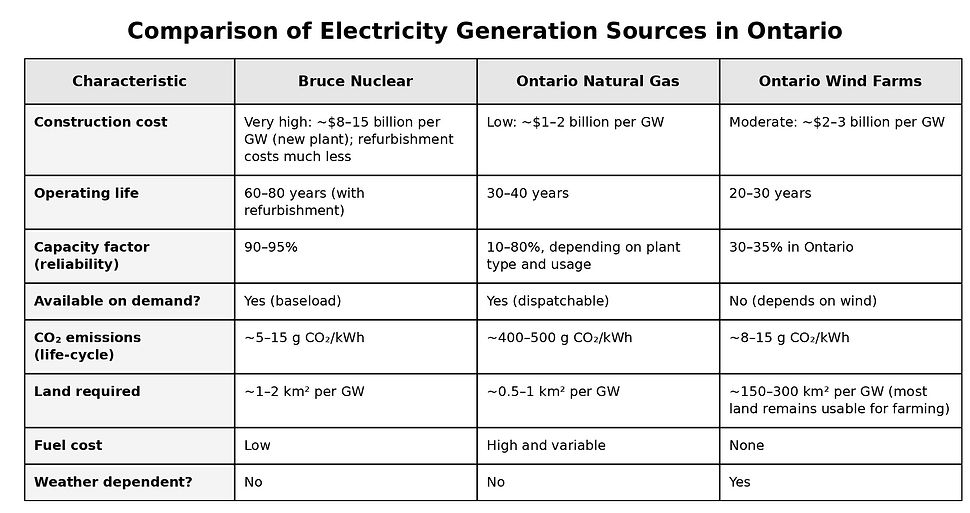
The debate over Ontario’s future energy mix ultimately reflects two competing visions. Advocates of nuclear expansion point to its high capacity factor (90–95%), long operating life of 60–80 years, low life-cycle emissions comparable to wind, and its status as dispatchable baseload power available regardless of weather. They argue that although construction costs are the highest of any generation source, these costs are amortized over decades of stable output, and that nuclear’s small land footprint and freedom from fuel-price volatility make it a dependable backbone for a grid facing doubling demand by 2050. This view has shaped the Ford government’s continued commitment to Bruce Nuclear’s expansion and to Small Modular Reactors at Darlington6.
Ecologically oriented organizations and renewable-energy advocates counter that wind and solar have become cheaper to build and faster to deploy than nuclear, without its unresolved waste-disposal burden or exposure to cost overruns and construction delays. They point to the plunging cost of renewable technology worldwide as evidence that decarbonization no longer requires accepting nuclear’s risks or price tag, and argue that intermittency — long cited as renewables’ central weakness — is increasingly manageable through battery storage systems such as BESS.
This pressure, combined with falling global renewable prices, is what drove the Ford government’s reversal from cancelling windfarm contracts to committing to 5,000–7,500 MW of new renewable capacity. The resulting Ontario policy is neither a pure nuclear strategy nor a renewables-led one, but a hybrid that keeps nuclear and gas as anchors while treating renewables and storage as a growing, increasingly indispensable complement.
Understanding why nuclear retains this anchor role, however, requires grappling with a contested premise underlying Ontario’s strategy: the claim that nuclear power is “clean” energy. Nuclear power’s central environmental strength lies in its carbon profile. Over its full lifecycle—mining uranium, building the plant, operating it, and decommissioning it—nuclear power emits roughly the same amount of carbon dioxide as wind power, and much less than natural gas or coal. While generating electricity, nuclear plants do not emit soot, sulfur dioxide, nitrogen oxides, or carbon dioxide, pollutants that contribute to smog, acid rain, and respiratory disease when released by fossil fuel plants. This is why many climate scientists and energy experts view nuclear power as an important low-carbon energy source.
Yet others remain concerned about its waste management, cost, and safety risks, and for good reasons: nuclear is clean only in terms of greenhouse gas emissions, not in terms of its broader environmental footprint.
Spent nuclear fuel remains hazardous for thousands of years and requires secure long-term storage. Although the volume of waste is relatively small, safely managing it remains a major and unresolved challenge. Serious accidents, while rare, illustrate the scale of risk involved. Three Mile Island (1979, USA) experienced a partial core meltdown; although it released little radiation, it triggered widespread public alarm. Chernobyl (1986, USSR) remains the worst nuclear accident in history, with massive environmental and political consequences. Fukushima (2011, Japan) triggered reactor shutdowns and policy reversals in several countries. These events demonstrate that even infrequent accidents can carry severe environmental, health, and economic costs.
Uranium mining, if not properly managed, can also damage ecosystems and expose workers and nearby communities to environmental hazards. Nuclear plants further require large amounts of water for cooling, affecting local rivers and coastal ecosystems through water withdrawals and thermal pollution. This is not a hypothetical risk. In August 2026, extreme conditions aggravated by the climate emergency drained Europe’s waterways from the Netherlands to the Black Sea; for the first time in their history, Hungary and Romania were forced to shut down atomic reactors cooled by the Danube 7.
The uranium that fuels reactors is not without its own problems. Uranium ore is naturally radioactive, and its radioactivity depends on the ore grade—the concentration of uranium it contains. Low-grade ore (e.g., 0.1% uranium) is only modestly more radioactive than ordinary rock, but high-grade ore (e.g., 10–20% uranium, found in parts of Canada) is far more radioactive and requires shielding and careful handling. Some ore from the Athabasca Basin contains over 20% uranium, making it among the richest uranium ore in the world; radiation levels can be high enough that miners must rely on remote handling and strict safety procedures.
Canada is a major source of this uranium, and the province’s own supply chain illustrates both the promise and the risks described above. Most uranium comes from the Athabasca Basin, a roughly 100,000-square-kilometre region in the Canadian Shield spanning northern Saskatchewan and Alberta, which currently supplies about 20% of the world’s uranium. Cameco Corporation, the world’s largest publicly traded uranium company, is based in Saskatoon, Saskatchewan, and operates a uranium refinery in Blind River and a uranium conversion facility in Port Hope 8.
Cameco is the exclusive fuel supplier to Bruce Power, which generates 30% of Ontario’s electricity through its nuclear plant—making this Canadian supply chain a direct link between the environmental tradeoffs discussed above and Ontario’s own energy strategy.
The region’s uranium capacity is also poised to expand significantly. NexGen Energy’s Rook I Project, an underground mine and mill development in the uranium-rich southwestern Athabasca Basin, is currently the largest development-stage uranium project in Canada 9.
On March 5, 2026, the Canadian Nuclear Safety Commission approved NexGen’s Environmental Assessment and issued a Licence to Prepare Site and Construct for the wholly owned project.
Construction on the $2.2-billion project is now underway, and the company estimates that once operational, the mine could produce over 13,000 tonnes of uranium annually, representing roughly 20% of current global supply 10.
A project of this scale would substantially deepen the Athabasca Basin’s role in the global uranium market, while also intensifying the mining, waste, and environmental oversight challenges discussed above.
Federal Support for Nuclear Expansion
Ontario’s Conservative government was not alone in backing nuclear expansion, including the build-out of SMRs. The federal Liberal government supported it as well. Natural Resources Minister Jonathan Wilkinson announced on October 25, 2022, that Ottawa would direct $970 million toward a project being developed by Ontario Power Generation (OPG): a 300-MW SMR built adjacent to the existing 3,500-MW Darlington Nuclear Generating Station in Clarington. Wilkinson remained in the energy portfolio — as Minister of Energy and Natural Resources — under Prime Minister Carney until April 2026 11.
In the fall of 2025, Carney and Ford jointly announced $3 billion in funding to support Ontario’s purchase of four BWRX-300 SMR units from GE Vernova Hitachi Nuclear Energy, the Japanese–American reactor manufacturer. Of that total, Ottawa committed $2 billion through the Canada Growth Fund, with Ontario covering the remainder. The funding is earmarked for four SMRs at the Darlington New Nuclear Project (DNNP), and in their joint announcement, Carney and Ford noted that Canada would become the first G7 country to build a grid-connected SMR 12.
Meanwhile, Ontario’s existing large-scale nuclear plants at Bruce, Darlington, and Pickering are undergoing refurbishments that have proven both costly and time-consuming. New Brunswick Power’s Point Lepreau Nuclear Generating Station went through a comparable process years earlier, and the experience gives some sense of what can go wrong: its 2009 refurbishment ran $1 billion over budget and took 4.5 years to complete — three years behind schedule. The delays stemmed largely from faulty tube installations, inexperienced contractors, and disputes between the utility and Atomic Energy of Canada Limited (AECL), the contractor responsible for the work. The project came to be regarded as one of North America’s worst-performing nuclear refurbishments 13.
Bruce Power’s recent work on Unit 3 illustrates just how involved a nuclear refurbishment can be. Crews cut an opening into the roof of the operating station, lifted out eight steam generators — each weighing roughly 100 metric tons (about 110 US tons) — and lowered replacements into the same opening. The unit returned to service on June 8, 2026 (Weekly Voice).
Unit 3 is a CANDU reactor on the shore of Lake Huron that entered commercial service in the late 1970s. Its refurbishment began in March 2023 as part of a broader effort expected to add 30 to 35 years to the reactor’s operating life 14.
The replacement steam generators themselves were manufactured by BWXT in Cambridge nearly two decades ago and sat in storage at the Bruce site until they were needed (Nuclear Engineering International). Lifting them into place fell to Mammoet’s PTC-35, a ring crane standing more than 100 metres tall 15.
Ontario’s Independent Electricity System Operator set a fixed cost of CAD $1.9 billion for the Unit 3 refurbishment when it approved the project in 2022. The Ontario Clean Air Alliance, an advocacy group, has since argued that the government has not released the original budget or final cost figures needed to independently verify that number 16.
Canada’s own experience with the waste question illustrates just how demanding this challenge is, both technically and financially. In November 2024, the Nuclear Waste Management Organization (NWMO) selected the Wabigoon Lake Ojibway Nation and the Township of Ignace, roughly 250 kilometres northwest of Thunder Bay, as the host community for the country’s first deep geological repository 17.
The proposed facility would bury close to 5.9 million bundles of used nuclear fuel between 650 and 800 metres underground, within a footprint spanning roughly two by three kilometres. 18.
The scale of this undertaking is matched by its cost. Initial construction alone is projected at a minimum of $4.5 billion over the coming decade, while the NWMO estimates the facility’s full lifetime cost—spanning an anticipated 175 years of operation—at roughly CA$26 billion. These costs will be recovered through fees charged to nuclear utilities, meaning they are ultimately embedded in the electricity rates Ontario consumers pay. The project is currently working through regulatory review 19.
Experience elsewhere suggests these projections may prove optimistic. Finland’s Onkalo facility, the world’s first operational deep geological repository, was originally budgeted at €503 million in 2003 but had climbed to roughly double that figure by 2023 20.
This pattern of substantial cost overruns is common to deep geological repository projects internationally, underscoring that the long-term burden of nuclear waste is not simply a matter of engineering, but one of sustained public expense that complicates any simple claim that nuclear power is “clean.”
Ontario’s experience, however, is only one chapter in a much larger global story; nuclear power today operates at vastly different scales across dozens of countries, each with its own mix of reactors, ambitions, and constraints.


Source: Statista (statista.com)21
Nuclear power’s global story begins in the 1940s, when the earliest reactors emerged from the Manhattan Project’s effort to produce plutonium for nuclear weapons. Chicago Pile-1, built in 1942, was the first reactor of any kind. Electricity generation followed a few years later: the Experimental Breeder Reactor I, located in the high desert of eastern Idaho near Arco, became the first reactor to produce electricity on December 20, 1951. The Soviet Union’s Obninsk plant followed in 1954, becoming the first nuclear facility to supply electricity to a public grid, and the United Kingdom’s Calder Hall opened in 1956 as the world’s first commercial-scale nuclear power station.
From these origins, nuclear power has since scaled unevenly across the globe, with a small number of countries now accounting for most of the world’s operating capacity. The United States remains the largest operator, running 94 commercial reactors across 54 power plants for a combined net capacity of roughly 97 gigawatts; nuclear power supplies about 18–19% of the country’s electricity, and the U.S. alone generates close to 30% of the world’s nuclear-generated electricity.
China ranks second in reactor count, with about 58.7 gigawatts of operational capacity across 60 reactors as of May 2026, though nuclear still supplies only 4.5–5% of the country’s electricity generation. China’s ambitions, however, extend well beyond its current fleet: it has 36 additional reactors under construction, representing nearly half of all nuclear capacity being built worldwide, and by the end of 2025 its combined operating, under-construction, and approved capacity exceeded 120 gigawatts, the highest total of any country 22.
China’s approach pairs this nuclear expansion with parallel investment in wind, solar, hydro, and storage, aimed at meeting long-term electricity demand while reducing reliance on coal. If current construction and approval trends continue, China is expected to overtake the United States in total installed nuclear capacity sometime in the 2030s.
France offers a different model altogether. With 57 reactors, it ranks third in the world by reactor count, but it is the global leader by share of electricity generated: nuclear power supplies roughly 65–70% of France’s total electricity, by far the highest proportion of any major economy. This concentration reflects a deliberate national strategy launched in the 1970s, when France moved to build out its nuclear fleet rapidly in response to the oil crisis, aiming for energy independence rather than incremental diversification. The result is a grid that, unlike those of the U.S. or China, relies on nuclear as its primary rather than supplementary power source.
Russia, the birthplace of commercial nuclear power through the Obninsk plant, remains a significant operator today, running 37 commercial reactors with a combined capacity of about 30 gigawatts, including several advanced fast-neutron reactors at its Beloyarsk plant.
Nuclear Power in Ontario
Set against this global backdrop, Canada’s fleet of 17 reactors is comparatively modest, and Ontario accounts for nearly all of it. Nuclear energy supplies roughly half of Ontario’s total electricity, generated across three stations: Bruce, Darlington, and Pickering. Each has its own story of construction and renewal, and together they illustrate both the promise and the cost of keeping a nuclear fleet running for half a century and beyond.
The oldest and largest of the three is the Bruce Nuclear Generating Station, sited on the eastern shore of Lake Huron near Tiverton. Bruce was Canada’s first nuclear station, and today it remains the largest operating nuclear facility in the world by installed capacity. Bruce A’s construction began in 1970. Unit 1 entered service in September 1977, and Units 2 through 4 followed over the next two years. A second phase, Bruce B, began construction in the mid-1970s and brought Units 5 through 8 online between 1984 and 1987, rounding out a fleet of eight CANDU reactors that all operate today. Together they produce about 6.6 gigawatts of power, enough to supply roughly 30 percent of Ontario’s electricity and, by extension, an estimated 6 million homes. Bruce was originally built and run by Ontario Hydro, but since 2001 it has been operated by Bruce Power under a long-term lease. Several of its reactors have since undergone major refurbishment, intended to keep them generating power into the 2060s.
Southeast of Bruce, in the municipality of Clarington, lies the Darlington Nuclear Generating Station, operated by Ontario Power Generation. Darlington’s four CANDU reactors were built between 1989 and 1993 at a cost of about $14.4 billion in 1993 dollars. That sum would translate to roughly $27.6 billion in today’s currency. Decades later, the station underwent a mid-life refurbishment of its existing reactors, completed at a cost of about $12.8 billion and reported as finished under budget 23.
Darlington’s significance extends beyond its four original units, too: the site is now home to North America’s first grid-scale Small Modular Reactor project, positioning it at the leading edge of Ontario’s next generation of nuclear development 24.
The third station, Pickering, lies just 35 kilometres from downtown Toronto and holds the distinction of being one of the oldest nuclear stations in the world, having entered service in 1971. Of its original eight CANDU reactors, six remain in operation today, together producing about 2.1 gigawatts. Pickering’s future, however, is now in transition. Its operating licence was set to expire in August 2028, and OPG has applied to renew it for a further ten years, coupled with a request to refurbish Units 5 through 8 at an estimated cost of $27 billion. The station’s two oldest reactors, Units 1 and 4, were already permanently shut down at the end of 2024, and the four remaining units are scheduled to follow at the end of 2026, when they will be taken offline and prepared for a multiyear refurbishment. If that work proceeds as planned, those units are expected to return to service by the mid-2030s.
Taken together, Bruce, Darlington, and Pickering represent a province that built much of its nuclear fleet in a single concentrated era, spanning the 1970s through the early 1990s. Ontario now faces the parallel challenge of refurbishing that aging infrastructure while also, at Darlington, beginning to build something new.
Beyond the ongoing refurbishments, Ontario is also gearing up for major new nuclear builds, including OPG’s proposed station in Port Hope and Bruce Power’s Bruce C project. The Port Hope station, planned for the Wesleyville site, could reach up to 10 GW of nuclear capacity, enough to supply an estimated 10 million homes. The project will now go through a multi-year federal impact assessment before construction can proceed.
Nuclear Construction Trends, Past and Present
When Bruce A Unit 1 entered commercial operation in September 1977, roughly 200 nuclear power reactors were already running worldwide — about half of all the reactors that would eventually be online by 1990. The late 1970s marked the peak of the largest nuclear construction boom in history. Between 1970 and 1990, the global reactor fleet grew from 84 units to more than 400, as country after country expanded nuclear generation in the wake of the 1973 oil crisis.
That boom, in the Western Hemisphere has largely faded. Today the United Kingdom stands nearly alone among Western nations in building large reactors, with two European Pressurized Reactor (EPR) units under construction at Hinkley Point C. The United States, France, and Canada currently have no large conventional reactors under construction, having shifted their attention instead toward Small Modular Reactors (SMRs).
Globally, the picture looks different. About 80 reactors are under construction across 15 countries, with roughly 120 more in the planning stages — and the great majority of that activity is happening in Asia 25.
China stands at the center of this new wave. The country currently has 36 reactors under construction, representing 44.1 gigawatt-electric (GWe) of capacity, a measure of electrical output rather than thermal power. That pace of build-out has not been matched since the United States and France constructed their own fleets through the 1970s and ’80s. Over just the past 15 years, China has added more nuclear capacity than the rest of the world combined.
The Shift to Small Modular Reactors
That decades-long pause in large nuclear construction across the Western Hemisphere has given way to a different kind of experiment: Small Modular Reactors (SMRs). Nowhere is this shift more consequential than in Canada, which has taken on the risks and the costs of deploying first-of-a-kind SMR technology at commercial scale.
While Ontario's other planned nuclear projects, at Port Hope and Bruce C, remain large-scale conventional builds, the same Darlington site already home to Ontario's aging fleet is now hosting a distinctly smaller-scale approach to nuclear power. North America's first grid-scale SMR is now under construction at the Darlington New Nuclear Project (DNNP) in Clarington, Ontario.26.
Ontario Power Generation (OPG) applied to the Canadian Nuclear Safety Commission for a licence to construct one General Electric Hitachi BWRX-300 reactor at the Darlington site in October 2022, and the Commission issued that construction licence on April 4, 2025, valid until March 31, 2035. The following month, the Province of Ontario approved a CAD 20.9 billion budget and authorized the start of construction for the first of four planned SMRs at the site 27.
The Darlington project represents Ontario’s first new nuclear build in more than 30 years. The utility is ultimately planning for four SMRs at Darlington, next to the existing Darlington nuclear power station, with the goal of generating up to 4,800 MW of electricity for the Ontario grid. The first unit is scheduled to come online by the end of 2030, expected to supply roughly 300 megawatts — enough electricity for approximately 300,000 homes.
Small Modular Reactors are a distinct class of nuclear technology: physically compact fission reactors, generally producing 300 MW(e) or less, designed to be prefabricated in factories and assembled on-site — an approach intended to shorten construction timelines, reduce upfront costs, and make nuclear power viable in more remote locations.
The reactor chosen for Darlington, the GE Vernova Hitachi BWRX-300, is a 300 MWe small modular reactor featuring natural circulation cooling and passive safety systems, built on the licensed ESBWR design and GNF2 fuel. The “X” in its name marks it as GE Hitachi’s tenth-generation boiling water reactor design28.
Construction Progress at Darlington
The project has moved steadily to physical construction. By early 2026, OPG had completed excavation work on the shafts supporting construction of the site’s first unit that reached 35 metres below grade29.
In May 2026, in that excavated shaft, workers lowered the reactor building’s foundation, a prefabricated unit weighing close to 953 tonnes and measuring 37 metres in diameter. Notably, it was fabricated, welded, and assembled off-site as a single module before being lifted into the shaft by one of the world’s largest crawler cranes, making it the first time in Canada that a reactor building foundation has been assembled modularly30.
The build itself rests on a delivery alliance linking OPG with major engineering and construction partners. Candu Energy, an AtkinsRéalis company, was awarded a CAD 450 million execution contract by OPG for the first of the four planned SMR units, while Aecon has carried out major site preparation and construction work at Darlington31.
That partnership structure has helped build a substantial domestic supply chain. More than 80 Ontario-based companies, including northern and rural suppliers, had already signed agreements with OPG and its partners to deliver the project, and by mid-2026 the supply chain had grown to more than 100 Canadian companies in total, with 16 additional Ontario firms and six from Quebec and Alberta joining32.
Ontario has positioned this first-mover status as an export opportunity, promoting the province’s SMR supply chain to European utilities in Poland and Finland that are pursuing their own SMR programs.
Ontario’s Energy Cost Comparison
According to Ontario Power Generation (OPG), the cost of building the Darlington New Nuclear Project, the first small modular reactor (SMR) fleet in a G7 country, is now several times higher than GE Hitachi Nuclear Energy, the reactor’s Wilmington, N.C.-based designer, originally projected. Early in development, GE Hitachi had set a target cost of US$700 million per reactor, or US$2.25 million per megawatt, a level meant to make the BWRX-300 competitive with natural gas33.
OPG has stated that the project will be financed not by government but by the utility itself, drawn from cash on hand, cash flow from its existing generating stations, and debt. Those costs will ultimately be recovered from Ontario ratepayers through their electricity bills. OPG estimates the average cost of power from the four planned reactors at 14.9 cents per kilowatt-hour, a projection that depends on the federal government delivering the investment tax credits it has promised.
By comparison, Ontario’s Independent Electricity System Operator (IESO) modelled an alternative path: building 5,600 to 8,900 megawatts of wind and solar capacity backed by battery storage. Because wind and solar are intermittent, the IESO noted, this approach would require substantially more installed capacity and new transmission infrastructure to match the reliability of nuclear. It estimated the cost of this renewable alternative at 13.5 to 18.4 cents per kilowatt-hour — and concluded that building the BWRX-300 remains the lower-risk option.
Independent analysts, however, have raised concerns about whether OPG’s costs undermine the case for SMRs more broadly. Clean Prosperity, a Canadian climate policy think tank, projected that a final cost near $3 billion — or $10.16 million per megawatt — would be needed to spark rapid SMR adoption elsewhere. This figure represents a forward-looking target for future SMR fleets, not a benchmark already achieved. By comparison, France and the U.S. historically built large conventional reactors at $12.5 million and $17.5 million per megawatt, respectively — costs that are themselves well above Clean Prosperity’s SMR target, illustrating how far even established nuclear construction costs remain from the threshold needed to make SMRs competitive. The International Energy Agency has gone further, stating in a January 2025 report that SMR costs must fall to US$4.5 million per megawatt by 2040 to achieve rapid uptake — a target further still from OPG’s current trajectory 34.
Reporting by the Globe and Mail put OPG’s official price tag for the first reactor at $7.7 billion — equivalent to roughly $25.7 million per megawatt on a 300 MW unit, well above the costs France and the U.S. paid for large-scale nuclear construction, let alone the threshold Clean Prosperity and the IEA describe as necessary for rapid SMR adoption elsewhere. For comparison, a recently completed 377-megawatt natural gas plant in Saskatchewan cost $825 million. Ed Lyman of the Union of Concerned Scientists called the figure unsurprising given what’s known about the poor economics of small nuclear reactors35.
The Darlington project, and its final price tag, is being closely watched by utilities worldwide, as the BWRX-300 design is also under consideration for projects in the U.S., U.K., Poland, and Estonia, among others.

Source: Energy Futures Ontario and Clean Air Alliance 36.
The infographic’s 3.1¢/kWh Energy Efficiency figure is specifically tied to the IESO 2025–2027 Demand Side Management Program Plan, page 7. The solar, wind, and nuclear LCOE figures are drawn from the IESO Annual Planning Outlook and the Energy Futures Group’s LCOE calculations (Table 3), which assume a 30% investment tax credit.
(Figures are drawn from two sources using different currencies: Energy Futures Group, a U.S.-based consulting firm, reports costs in U.S. dollars, while the Ontario Clean Air Alliance reports in Canadian dollars. To compare across the two, U.S.-dollar figures can be converted to Canadian dollars by multiplying by 1.39) 37.
This IESO comparison, however, is not the only cost estimate in circulation — a separate levelized-cost analysis paints a starkly different picture.
The chart compares the levelized cost of electricity (LCOE) — the average cost of producing one megawatt-hour (MWh) of electricity over a project’s lifetime — for several technologies. It assumes projects are built for 2030 and receive a 30% investment tax credit.
The comparison shows that renewable energy is projected to be much less expensive than new nuclear power. Utility-scale solar has the lowest estimated cost at about US$41/MWh, followed by onshore wind at US$27–43/MWh. Offshore wind is more expensive than solar and onshore wind, but still relatively economical at US$86–93/MWh. In contrast, new large conventional nuclear power plants are estimated to produce electricity at US$206–226/MWh, making them roughly five times more expensive than solar and about five to eight times more expensive than onshore wind. First-of-a-kind small modular reactors (SMRs) are projected to be even more expensive, at US$211–232/MWh, while later SMR units, after experience lowers costs, are expected to fall to US$159–174/MWh. Even these later SMRs, however, remain substantially more expensive than wind and solar.
Overall, the chart illustrates the claim that, under the stated assumptions, renewable electricity sources — especially solar and onshore wind — can generate power at far lower cost than new nuclear plants or SMRs. Offshore wind occupies a middle position, costing more than solar and onshore wind but considerably less than new nuclear technologies.
This conclusion is echoed by the Ontario Clean Air Alliance (OCAA), a Toronto-based advocacy group whose research arm, Ontario Clean Air Alliance Research Inc., produces the studies and reports underpinning its advocacy work. OCAA states that power from new nuclear reactors, including Darlington, will cost up to eight times more than power from onshore wind turbines.
OCAA first made its name leading the successful campaign to phase out Ontario’s coal-fired power plants, and is now working toward a zero-carbon electricity grid by 2035, primarily through energy conservation and efficiency, cost-effective made-in-Ontario green energy, and energy cooperation with neighbouring jurisdictions. The group opposes nuclear power expansion, arguing that new nuclear reactors are the most expensive way to produce electricity — two to eight times costlier than onshore wind and solar. It bases this claim on sources including Lazard, Ontario’s grid operator (IESO), and the Energy Futures Group 38.
One vocal critic of the Ontario government’s plans to expand the nuclear program is Mark Winfield, a professor of Environmental and Urban Change at York University and a frequent expert contributor to OCAA. In a February 2025 opinion piece, Winfield argued that any sound economic strategy for Ontario should prioritize controlling energy costs over expanding energy production.
Winfield noted that the Pickering B and Darlington new-build projects mark only the beginning of the province’s nuclear expansion plans. Additional projects proposed for Wesleyville and the Bruce nuclear site, he wrote, could push total capital expenditures past $300 billion. He pointed out that the Ford government has not disclosed what its nuclear expansion program will ultimately cost or how it would be financed. He highlighted a proposed 10,000-megawatt facility at Wesleyville, between Cobourg and Kingston, floated just before the election call, which could alone break the $200-billion mark in capital costs. A second proposed facility — a 4,800-MW plant at the Bruce nuclear site — would add roughly $100 billion more on the same basis.
Ultimately, the debate over nuclear costs in Ontario comes down to a fundamental disagreement over framing: whether nuclear’s high upfront capital costs and long construction timelines are outweighed by its low emissions, reliability, and long operating life — or whether, as critics like OCAA and Winfield contend, cheaper and faster-to-deploy renewables make nuclear expansion an unnecessary economic gamble for ratepayers 39.
These competing cost estimates—whether measured in cents per kilowatt-hour or dollars per megawatt—ultimately trace back to the same underlying reality: nuclear power’s economics, its risks and benefits, are inseparable from the physical process happening inside the reactor core itself.
The Physics of Nuclear Fission in CANDU Reactors
To better understand the issues surrounding nuclear energy, whether generated by traditional large-scale plants or by planned Small Modular Reactors (SMRs), it is necessary to first examine the physical processes occurring within a reactor core. This report traces the mechanism by which uranium fission is initiated and sustained, using the Bruce Nuclear Generating Station, a CANDU-type facility, as a reference case.
The Fission Process
Within a reactor such as Bruce, the process begins at the atomic level. Natural uranium consists predominantly of Uranium-238, with only a small proportion of the fissile isotope Uranium-235, fissile meaning that it is capable of splitting upon absorbing a neutron. When a free neutron strikes and is absorbed by a Uranium-235 nucleus, the nucleus is transformed into Uranium-236, a highly unstable configuration that persists for only a fraction of a second before disintegrating. As it breaks apart, the nucleus releases two smaller radioactive fission products, two to three new neutrons, and a substantial quantity of heat energy. These newly liberated neutrons then go on to strike further Uranium-235 nuclei elsewhere in the fuel, propagating the reaction outward in a self-sustaining sequence. When this chain reaction is properly regulated, it settles into a steady and continuous source of heat, suitable for generating electricity.
Initiating the Reaction in a CANDU Reactor
A CANDU reactor such as Bruce is fuelled with natural uranium dioxide, in which Uranium-235 makes up only about 0.7 percent of the material, too little to sustain a reaction on its own without assistance in getting started. For this reason, the reactor is brought to criticality through a dedicated startup procedure: a small neutron source is inserted into the core, while adjuster rods and control rods are manipulated to establish the first self-sustaining chain reaction. This is made possible in part by the reactor’s use of heavy water, or D₂O, as a moderator. Heavy water slows neutrons with particular efficiency, a property that allows natural, unenriched uranium to be used as fuel in the first place. Once the reaction is underway, control rods and liquid neutron absorbers work continuously to regulate the neutron supply, holding the reaction at the desired power level.
The Role of the Startup Neutron Source
The small neutron source used to begin this process is a device that emits a low but steady stream of neutrons. It plays no role in powering the reactor; its sole function is to supply the initial neutrons needed to set the controlled chain reaction in motion. The most commonly used sources for this purpose are Americium–Beryllium (Am-Be) devices, though Californium-252 (Cf-252) is also employed.
During startup, this source provides the very first neutrons to enter the fuel. As Uranium-235 nuclei begin to fission in response, each releases two to three neutrons of its own, and within a short span of time the reactor’s own fission process comes to generate vastly more neutrons than the original startup source ever supplied. The source’s contribution therefore becomes, for all practical purposes, insignificant almost as soon as the chain reaction takes hold. In this way, the chain reaction is started in a manner that is both predictable and fully controlled.
The Fuel Bundle During Operation
It is worth noting that the onset of fission does not compromise the physical integrity of the fuel itself. The fuel bundle remains intact throughout normal operation, and only a small fraction of the uranium atoms within the fuel pellets undergo fission on any given day. The pellets and their surrounding metal cladding are engineered to withstand years of continuous reactor operation, containing the fission process safely within their structure even as it proceeds.
Fuel Bundle Design and Lifecycle in a CANDU Reactor 40

The accompanying diagram illustrates the structure of a CANDU reactor and the pathway its fuel follows over the course of operation40. At the core of this design is the fuel itself, which consists of small ceramic pellets of uranium dioxide (UO₂), within which the fission process described earlier takes place. Although these pellets reach considerable temperatures during operation, typically several hundred degrees Celsius, and over 1,000°C at their centre, they remain solid throughout, as uranium dioxide does not melt until approximately 2,800°C.
Each pellet is sealed within a thin tube of zirconium alloy, known as cladding, which together with the pellets forms the fuel bundle. This cladding serves several essential functions: it retains the radioactive fission products generated during fission, prevents direct contact between the fuel and the heavy-water coolant, and permits heat to be transferred efficiently from the fuel to the coolant surrounding it. Over the course of years in service, the bundle undergoes gradual change, as the cladding accumulates radiation damage and minor deformation, yet it is engineered specifically to remain intact under normal operating conditions throughout its service life.
These fuel bundles are loaded into the reactor vessel, known as the calandria, and are continually replaced while the reactor remains in operation. After a period of roughly twelve to eighteen months, a given bundle’s energy output declines to the point where it is no longer efficient to continue using it, at which point it is removed from the reactor and replaced with fresh fuel. Although spent, the removed bundle remains physically recognizable in form. It is, however, highly radioactive and continues to generate heat through the ongoing decay of its fission products. For this reason, it is first transferred to a water-filled spent fuel pool, where it is cooled and shielded, before eventually being moved to dry storage for longer-term management.
Understanding this sequence, from the initial absorption of a neutron, through the establishment of a self-sustaining chain reaction, to the sustained integrity of the fuel itself, provides the necessary technical foundation for evaluating broader questions of nuclear safety, control, and viability, whether in the context of established facilities like Bruce or emerging SMR designs.
Having looked at how fuel bundles are engineered, loaded, and cycled through a CANDU core, it makes sense to turn to a reactor family that does away with solid fuel bundles altogether: Molten Salt Reactors.
The Rise of Molten Salt Power
An important class of Small Modular Reactors are the Molten Salt Reactors (MSRs). It is a newer concept and still under development. It has significant advantages over BWRs, which are currently entering the construction phase. The basic difference is that MSRs do not use water to cool the reactor, as BWRs do. Instead, they use molten salt, which boils at significantly higher temperatures than water and thus provides a wide safety margin for reactors functioning at lower temperatures. This allows for simplification of the technical design, although it introduces its own special safety features to counteract the highly corrosive nature of molten salt. Several designs are under development in the US, Europe, and other countries, and China already has a functioning MSR 41.
In recent years, molten salt reactors have gained increasing attention as a potential solution to the compounding crises facing the global energy sector: climate change, intensifying geopolitical conflicts, and the AI boom, to name a few critical examples 42.
US Heavily Involved in MSRs
Molten salt reactors are nothing new. They have been around since the 1960s and date back to the days of the Molten Salt Reactor Experiment at Oak Ridge National Laboratory. After a hiatus of several decades, the concept met with renewed interest, and the US now conducts extensive research on molten salt reactors.
The U.S. Department of Energy (DOE) funds initiatives such as the Advanced Reactor Demonstration Program to test next-generation reactor fuels, improve safety, and identify corrosion-resistant materials. This research is led by several major national laboratories and private companies, including Idaho National Laboratory (INL), which hosts the Molten Salt Thermophysical Examination Capability (MSTEC) and has produced full-scale batches of enriched fuel salt for the upcoming Molten Chloride Reactor Experiment (MCRE) 43.
Oak Ridge National Laboratory (ORNL), the birthplace of MSRs in the mid-20th century, continuously tests new methods to track chemical changes and simulate reactor cores44.
Private Sector Development
Private developers are also advancing molten salt technology. TerraPower, backed by Bill Gates, has been researching molten chloride fast reactors alongside testing facilities at various national laboratory sites 45.
The company has partnered with Southern Company, a leading U.S. energy company, to develop the Molten Chloride Fast Reactor (MCFR), which uses liquid chloride salts as both coolant and fuel. In this design, the salts flow directly through the reactor core, allowing fission to heat them in place rather than relying on a separate coolant medium 46.
Fuel Breakthrough Opens Path to Maritime Nuclear Power
Idaho National Laboratory announced in late 2025 that it had successfully manufactured fuel for the Molten Chloride Reactor Experiment (MCRE) for the first time, a milestone described by MCRE senior technical advisor Don Wood as opening the door to using molten salt reactors aboard ships. He noted that the technology could give vessels a compact, low-maintenance nuclear power source that cuts emissions and supports long, uninterrupted voyages without refueling 47.
The achievement, reported in December 2025, represents progress toward commercial maritime deployment of fast molten salt reactor technology 48.
The MCRE program is a joint effort between Southern Company, TerraPower, and CORE POWER, working toward the full-scale commercial MCFR design described above.
How the MCFR Works
The commercial MCFR design targets an electrical output of up to 1,200 megawatts. Once the fission-heated fuel salt leaves the core, it passes through a heat exchanger into a separate loop of coolant salt, which can be tapped for generating electricity, supplying industrial process heat, or storing thermal energy.
Because the reactor runs at much higher temperatures than conventional designs, it converts heat to electricity more efficiently. Traditional light water reactors operate around 300°C under pressurized conditions and typically convert only 30 to 33% of their heat into electricity. The MCFR, by contrast, runs above 600°C, which alone improves on that baseline efficiency. Molten salt reactor designs, operating in the 600 to 700°C range, can push electrical conversion efficiency up toward 40 to 50% while also generating high-temperature heat usable for industrial processes.
The design also produces less nuclear waste overall, and the MCFR has the added potential to consume spent fuel from other reactor types as part of its fuel cycle.
MSRs vs BWRs
The molten salt reactors (SMRs) offer various advantages against the Boiling Water Reactors (BWRs), one of them being the thermal storage, for industrial uses.
The BWRX-300 is a 300 MWe water-cooled Small Boiling Water Reactor designed by GE Hitachi. It mitigates cooling vulnerabilities primarily through natural Circulation.
Because hot water naturally rises while cold water sinks, the physics of the reactor loop keep water flowing over the fuel automatically. If an emergency occurs, isolation valves open, and cooling water drops into the reactor core purely via gravity from elevated pools, requiring no pumps or electricity.
Liquid Metal or Gas-Cooled SMRs Designs using sodium or helium generally do not boil like water-cooled reactors. They rely on conduction, radiation, and natural convection to transfer heat directly to the atmosphere through structures like the reactor vessel wall.
The BWRX-300 small modular reactor operates at a high pressure of 7.2 MPa [requiring reinforced metal pipes] with a coolant inlet temperature of 270°C (518°F) and a steam outlet temperature of 288°C (550°F). Because it is a boiling water reactor, it maintains these lower, saturated steam temperatures.49
The GE Vernova BWRX-300 operates at a lower electrical efficiency of roughly 34.5%, which lags behind the 40% to 50%+ efficiencies of high-temperature gas-cooled reactors (HTGRs) and molten salt reactors (MSRs). Because the BWRX-300 relies on water as both coolant and moderator, it is limited by thermal ceiling dictated by water's properties.50
Thermal Efficiency Comparison
Comparison of core outlet temperature, approximate electrical efficiency, and primary power cycle across representative SMR reactor design concepts.
High-Temperature Designs Outperform the BWRX-300 Because the BWRX-300 caps its steam output at 288°C, its theoretical maximum efficiency is fundamentally restricted compared to a reactor operating at 700°C.
To keep water liquid or stable even at 288°C, the BWRX-300 must operate under an intense pressure of 7.2 MPa. Gas and molten salt designs can reach massive temperatures at or near normal atmospheric pressure, removing heavy structural containment requirements and allowing fluids to absorb far more heat energy.
The physical makeup of light-water fuel dictates why the BWRX-300 must operate at a much lower temperature (288°C) than advanced alternatives: If the reactor temperature gets too high, the zirconium alloy cladding of pellets containing the fission material degrades, oxidizes, or reacts chemically with the water coolant. At extreme temperatures, volatile fission gases (like xenon and krypton) expand rapidly inside the solid ceramic pellets, creating intense internal pressure that could crack the fuel rods.
The low-temperature heat from a BWRX-300 is mostly restricted to district heating while the extreme heat from gas and salt SMRs can drive high-efficiency industrial processes like clean hydrogen production via high-temperature steam electrolysis.
The Trade-off: Efficiency vs. Deployability
While the BWRX-300 is less efficient, it holds a distinct practical advantage: it utilizes standard, commercially available light-water nuclear fuel and established supply chains. This allows utilities like Ontario Power Generation to license and construct them much sooner than yet unproven high-temperature alternatives.
The BWRX-300 is seemingly simpler to construct. It utilizes a boiling water design with a simplified direct steam cycle, requiring far fewer pumps and valves than traditional reactors. Because it relies on standard water cooling and proven, existing nuclear supply chains, its components are already manufactured worldwide. From an economic standpoint, the BWRX-300 is built around the principle of simplification and a design-to-cost approach.
In contrast, Molten Salt Reactors (MSRs) require advanced, specialized metallurgy to withstand extreme chemical corrosion and high operating temperatures.
When construction costs are instead measured per kWe of usable electricity output, however, the comparison yields a markedly different result. Cost comparison remains tentative as none of the models have been in operation in the West yet.
For the BWRX-300 (Darlington Unit 1), the capital cost is estimated at $6.1 billion CAD for a 300 MWe capacity, yielding a cost intensity near $20,333 CAD/kWe. Molten Salt Reactors (MSRs) speculative projections range from $2,800 to $10,000 CAD/kWe, which means that theoretically, Molten Salt Reactors (MSRs) are designed to be cheaper to build and operate than traditional water-cooled reactors like the BWRX-300.
SMRs in Europe
Critics of nuclear power's costs are not the only issue in this debate — the underlying tension between nuclear and renewables has much deeper roots, particularly in Europe, where it has shaped both policy and public opinion for decades.
Concetta Formisano of the Università Federico II di Napoli explores this history in research published through Blue Europe, a European think tank focused on energy policy, geopolitics, and the continent's transition to carbon-free electricity. As she notes, debates over sustainability, renewable energy, and the broader energy transition have been among the most active policy discussions in Europe since the 1980s. It might be tempting to assume that the 1986 Chernobyl disaster alone closed the door on nuclear development in favour of renewables.51
That political and ideological legacy is worth bearing in mind as we turn to a very different chapter of Europe's nuclear story: the renewed research push behind Molten Salt Reactors (MSRs) — a next-generation technology that its advocates argue could sidestep many of the safety and waste concerns that fuelled anti-nuclear sentiment in the first place.52
Sweden and the UK Advance BWR-Based SMR Deployment
Sweden and the United Kingdom have both opted to build their small modular reactor programs around boiling water reactor (BWR) technology, following a design lineage originally developed jointly by the United States and Japan. GE Vernova Hitachi Nuclear Energy (GVH) is positioning its BWRX-300 design as the foundation for a broader industrial ecosystem spanning Sweden and the wider European market.53
In the UK, Rolls-Royce SMR is leading construction of the country's first small modular reactors, working in partnership with the government-backed developer Great British Energy – Nuclear. The two organizations signed a contract in April 2026 clearing the way for immediate work on three Rolls-Royce SMR units at Wylfa, on the Isle of Anglesey in North Wales, with the reactors expected to enter service by the mid-2030s.54 The program is government-backed and is projected to support as many as 3,000 construction jobs.55 As of July 2026, the lead contractor for civil engineering and major construction management had not been publicly announced, though several global infrastructure firms are understood to be in contention.56
A separate, privately financed effort is also taking shape in the UK. Synthos Green Energy (SGE), a £35 billion consortium led by Polish industrialist and former rally driver Michał Sołowow, has advanced plans to build 14 SMRs across the UK using the BWRX-300A design, in partnership with GE Vernova and Hitachi.57 SGE already has BWRX-300 projects under development in Poland and elsewhere in Europe, and says it has invested $66 million so far toward preparing its UK application.58 At a signing ceremony, the company outlined a timeline for the project: entry into the UK's Advanced Nuclear Pipeline in November 2026, site selection and negotiation of government support schemes during the first half of 2027, a final investment decision in 2030, and commercial operation of the first unit by 2034.
Molten Salt Reactor Development Across Europe
Molten salt reactor designs are being pursued by developers across several European countries. Thorizon One, a Franco-Dutch company, is working on a 100 MW project backed by the European Commission. The company has launched a test facility in the Netherlands, with a nuclear demonstrator targeted for 2028 and a commercial reactor planned by 2034.59
In France, the startups Stellaria and Naarea are each developing molten salt micro-reactors designed to generate clean energy while also recycling long-lived nuclear waste. Both companies are supported by the French government and by European investment initiatives.
In the UK, MoltexFLEX — a subsidiary of Moltex Energy Limited — has launched its FLEX molten salt reactor design at a site in Warrington, North West England.60 The FLEX design uses two separate molten salts: one serves as the fuel, while the other circulates as a coolant, carrying heat away from the reaction through natural convection rather than relying on mechanical pumps. The company says the compact design could fit within a footprint no larger than a two-storey house while generating enough power for roughly 40,000 homes.
The reactor is intended to supply clean power for decarbonizing heavy industry. Each unit is designed to deliver 40 MW of thermal energy at 700°C, with that heat stored in MoltexFLEX's GridReserve thermal storage tanks — allowing the plant to release up to three times its baseline output during periods when renewable generation falls short of demand. This gives the technology an operating flexibility comparable to gas-fired power stations, with the ability to idle automatically and ramp back up to full power quickly, making it well suited to working alongside wind and solar.
MoltexFLEX CEO David Landon framed the design as a response to the gap left when solar and wind generation drops off, arguing the grid needs a power source able to step in during those lulls.61
The technology could also potentially be used to power cargo ships. MoltexFLEX has said the FLEX reactor is designed to cost no more to build or operate than a comparable gas or coal plant. The company has since moved from pre-concept research into an accelerated delivery phase, with a first operational reactor targeted for 2029.62
Danish Developers Revive a 1950s Concept
Small Danish nuclear developers — among them Copenhagen Atomics and Seaborg Technologies — have revived the molten salt reactor concept, which was first tested during the 1950s and 1960s at Oak Ridge National Laboratory (ORNL) in Tennessee.
Seaborg Technologies, now operating under the name Saltfoss Energy, is a Danish nuclear energy startup developing compact molten salt reactors designed to be housed on floating power barges.
The compact molten salt reactor CMSR is integrated into a floating non-self-propelled power barge. The CMSR promises clean, and affordable energy that would be less expensive than fossil fuels.63 One of its designs, the SmTMSR-400, features a reactor vessel measuring only 10 meters tall and 3.8 meters in diameter.
Other developers push the compactness even further. Copenhagen Atomics is developing a 100 MW-thermal breeder molten salt reactor designed to fit inside a single hermetically sealed shipping container, designed for seawater desalination. It is meant to solve the problem of water shortages in coastal cities and islands, especially in the Middle East, where precipitation is extremely lacking. The desalination plants of Saudi Arabia account for 24% of the total desalination in the world.63
A Swiss Subcritical, Accelerator-Driven Reactor Design
The Swiss company Transmutex is developing a reactor design that never reaches a self-sustaining chain reaction on its own. The core is built to run a few percent short of the neutrons it would need for criticality, with the shortfall supplied externally by a particle accelerator firing protons into a metal target inside the reactor. Because the reaction depends on that external neutron source, halting the proton beam shuts the reactor down — a built-in safety feature not available to conventional critical reactors.64
The system is designed to run on waste material left behind by other reactors, effectively transmuting long-lived radioactive waste into material with a far shorter hazardous lifespan. Transmutex has joined the Canadian Nuclear Isotope Council, and in that announcement named the two machines central to its program: HI-BEAM, an accelerator intended for producing medical isotopes, and START — short for Subcritical Transmuting Accelerated Regenerative Technology — the reactor designed specifically to burn spent nuclear fuel.
South Korea’s Nuclear-Powered Shipping
South Korea is also advancing nuclear-powered commercial shipping designs, recently securing preliminary approval for a 15,000 TEU container ship powered by molten salt small modular reactors. Key organizations involved include the Korea Research Institute of Ships and Ocean Engineering (KRISO) and the Korea Atomic Energy Research Institute (KAERI).65
Separately, South Korea has lined up one of the world's largest shipbuilders, Samsung Heavy Industries, to build floating nuclear power platforms based on a Danish reactor design. The concept involves stacking two to eight compact reactor units per hull, with each platform capable of delivering up to 800 megawatts.66
There is also an American dimension to this work: the fuel salt involved is being tested in Idaho. Idaho National Laboratory previously operated a molten salt reactor experiment in the 1960s, before the technology was set aside in favor of water-cooled reactor designs that went on to dominate the industry. The laboratory has since reentered the field, opening the Molten Salt Thermophysical Examination Capability under its National Reactor Innovation Center to test molten salt as a reactor coolant, as an alternative to conventional pressurized water systems.
China's Thorium Reactor Claim and America's Response
China has stated that it has operated a thorium molten salt reactor since October 2023, a claim that has added pressure on Washington to accelerate its own next-generation nuclear development.67 In response, Florida-based startup AMPERA has 3D-printed a subcritical, solid-state reactor core and pressure vessel — a step the company describes as the foundation for a fully factory-built thorium power system, and one it characterizes as the first of its kind. AMPERA founder and CEO Brian Matthews has framed the new core and pressure vessel as groundwork for nuclear energy that could eventually be mass-produced in a factory setting.
Advocates point to several potential advantages of thorium over conventional uranium fuel: thorium reactions are self-limiting, which lowers meltdown risk; thorium is harder to convert into weapons-grade material; and its spent fuel has a shorter radioactive half-life, meaning it remains hazardous for a shorter period. Thorium is also more abundant and generally easier to source than uranium, a factor that proponents argue could strengthen the resilience of nuclear fuel supply chains — including reducing US dependence on Russia, which currently controls roughly 44 percent of global uranium enrichment capacity.68
China's success in constructing and operating a thorium molten salt reactor represents an important breakthrough in advanced nuclear technology, and it has set off alarm bells in the United States, which sees the achievement as evidence that its main strategic competitor has pulled ahead in an emerging and potentially transformative reactor design.
Thorium as nuclear fuel
The concept of using thorium as reactor fuel is not new, however; it was already attempted more than sixty years ago at the Indian Point Energy Center in Buchanan, New York, on the east bank of the Hudson River about 36 miles (58 km) north of Midtown Manhattan. The station's two operating reactors, Indian Point 1 and Indian Point 2, together generated roughly 2,000 megawatts of electrical power, supplying about 25% of New York City's electricity demand at the time. Indian Point 1, a 275-megawatt pressurized water reactor, was intended to be the world's first commercial thorium-fuelled reactor.69
Thorium (symbol Th, atomic number 90) is a weakly radioactive, light silver metal and one of the most abundant heavy elements in the Earth's crust. It first drew the attention of nuclear scientists during the Manhattan Project in 1943, when it was studied alongside uranium as a potential material for building a nuclear bomb. During the Cold War, the United States went on to explore whether thorium-232, a naturally occurring thorium isotope, could serve as a source of uranium-233, a fissile isotope usable in nuclear weapons; a test device based on this approach, codenamed MET, was detonated in 1955. Subsequent testing, however, showed uranium to be the more practical weapons fuel, and the thorium-based approach was set aside.
Thorium fared no better as a civilian reactor fuel at Indian Point. It had to be mixed with highly enriched uranium, which made it more expensive than a conventional uranium fuel cycle, and it failed to live up to expectations. The plant's thorium-based core was shut down in 1965, after which Indian Point 1 operated on uranium dioxide fuel for the remainder of its service life.
Thorium's central limitation is that it is "fertile" rather than "fissile": thorium-232 cannot sustain a chain reaction on its own and must first absorb a neutron inside an operating reactor to be converted into fissile uranium-233.70
This extra conversion step, combined with its poor suitability for weapons production, is largely why thorium was abandoned during the Cold War. With nuclear energy programs of the era tied closely to military objectives, uranium-based fuel cycles were simply better suited to building nuclear arsenals, and thorium research fell out of favor as a result.
The idea was never fully abandoned, however. The rapid worldwide proliferation of nuclear power plants raised concerns about the long-term availability of uranium, a large share of which comes from Russia, and interest in thorium has since been renewed by scientific breakthroughs in converting it into usable fissile fuel.
These properties have spurred research into a diverse range of new reactor designs built around thorium fuel, many of which promise simpler engineering solutions and the elimination of water as a coolant altogether. Substantial funding has gone into this research in the United States, in several European countries, and in India, which holds large domestic thorium deposits and views the fuel as a path to energy self-sufficiency as it pursues a major expansion of its nuclear power sector.
The resulting variety of reactor designs reflects differing judgments about the relative benefits and drawbacks of thorium-fuelled reactors compared with both traditional water-cooled plants and the small modular reactor (SMR) models now being developed and deployed.
Thorium Fuel Designs
The table compares two very different ways of putting thorium to work in a reactor: as a solid fuel in a conventional water-cooled reactor, or dissolved directly into the coolant in a molten salt reactor (MSR). It's worth stressing upfront that neither pathway exists as a proven, commercially operating thorium reactor anywhere in the world today.
The only exception is China's small 2-megawatt TMSR-LF1 prototype in Gansu Province, an experimental molten salt design that reached full power in 2024 and, in late 2025, became the first reactor anywhere to demonstrate thorium-to-uranium fuel conversion in operation. Even China describes this as an experimental platform rather than a commercial reactor, with a 100-megawatt demonstration plant not targeted for completion until 2035 and commercial operation until 2040.
No solid-fuel thorium reactor of any scale has been built and operated commercially by anyone. With that caveat in place, the trade-offs in the table follow largely from the underlying design choice.
Solid-fuel thorium designs would inherit the most familiar element in the comparison: water cooling and the general architecture of conventional reactors, the same approach Ontario's own nuclear plans favor. In principle, this offers a simpler path toward eventual deployment, since a solid-fuel thorium reactor could reuse established fuel fabrication, reactor materials, and operating procedures.
But that familiarity applies to the underlying reactor technology, not to thorium as a solid fuel itself, which has never been demonstrated commercially. The fuel-cycle problems specific to this approach are real: once sealed inside fuel rods, thorium and its intermediate product, protactinium-233, cannot be chemically managed while the reactor runs, protactinium can absorb neutrons before decaying into useful uranium-233, and reactors must periodically shut down for refuelling. Solid-fuel designs also inherit the traditional risks of high-pressure water cooling, including the potential for rapid steam release or hydrogen generation in an accident.
Molten salt reactors invert this trade-off almost point for point — and China's prototype offers early, if limited, real-world support for the theory, even though it remains a small experimental unit rather than a commercial design. Because the fuel is liquid, it can in principle be chemically processed while the reactor operates, allowing protactinium to be removed and isolated so it decays into uranium-233 with fewer neutron losses.
Operating at high temperature without high pressure also reduces the risk of steam-related accidents, and some MSR concepts add passive drainage of fuel into subcritical tanks during an emergency.
These advantages come at a steep price in complexity and remain largely unproven at scale: outside China's single prototype, the online chemical-processing systems central to the MSR concept have never been demonstrated commercially, and hot, radioactive molten salts introduce corrosion, tritium-control, and materials challenges that conventional water-cooled reactors do not face.
On waste, the two paths converge somewhat: both may reduce certain long-lived transuranic waste relative to conventional uranium fuel cycles, though molten salt systems introduce their own new waste streams that require treatment methods not yet fully developed.
The table's own summary captures the essential tension well: a solid-fuel thorium reactor would offer a simpler, more readily deployable path by building on conventional reactor technology, but with less flexibility to optimize the thorium breeding cycle; a thorium MSR is potentially better suited to that optimized cycle, but remains far more technically complex and, apart from China's single small-scale prototype, entirely unproven.
In both cases, what Ontario's current nuclear plans treat as "familiar" is the conventional water-cooled reactor as a technology class — not thorium fuel, which has no commercial track record in either configuration.
This comparison between conventional and molten salt approaches to thorium fuel is, in many respects, a preview of a larger pattern shaping the global nuclear industry: countries are no longer content to simply refine existing reactor designs, but are actively racing to deploy genuinely new ones at commercial scale. That race has, so far, been led not by the United States or its Western allies, but by Russia and China, both of which have moved beyond laboratory prototypes to put small modular reactors into actual grid-connected operation. Their experience offers an early, real-world test of whether the promises made for next-generation reactor designs — including many of the same trade-offs just discussed for thorium — can survive contact with commercial deployment.
Russia and China: Pioneers in SMR Deployment
Although dozens of small modular reactor (SMR) designs are currently under development worldwide, only two have actually been built and put into operation: Russia's KLT-40S, located in Chukotka in the country's Far East and commissioned in 2018, and China's HTR-PM in Shandong Province, completed in 2021.
The KLT-40S is a pressurized water reactor installed aboard the Akademik Lomonosov, the only floating nuclear power plant currently in operation. The vessel carries two KLT-40S units with a combined output of 70 MW, supplying electricity and heat to Pevek, a small Arctic mining town.71
China's HTR-PM, by contrast, is a fourth-generation high-temperature gas-cooled reactor using pebble-bed fuel technology. It began commercial operation in December 2023, with its two reactor units driving a single 210-MWe turbine.
Though the successful construction of these two reactors represents a technical milestone that other SMR programs around the globe have yet to match, their actual operating performance has been subject to criticism. Analysis from Mycle Schneider Consulting found that the HTR-PM ran at a load factor of only about 10 percent through 2022, while Russia's two KLT-40S units performed only marginally better, at 26.4 and 30.5 percent respectively over the same period.72 Meanwhile, the price tag for the Akademik Lomonosov project has ballooned to more than triple its original 2006 estimate.73
Taken together, these early results suggest that while SMR technology has cleared the hurdle of physical construction, proving that reliable, cost-effective performance at commercial scale remains a far more difficult challenge.
The ARC-100: New Brunswick's Bet on Next-Generation Nuclear
While Europe and South Korea pursue molten salt reactor designs and floating nuclear platforms, Canada is pursuing a different approach. In New Brunswick, the ARC-100 represents a departure from the reactor technology chosen by Ontario, with backers arguing it offers distinct advantages should it reach commercial deployment.
NB Power has partnered with ARC Clean Technology Canada to develop the ARC-100, a small modular reactor intended to reduce the province's carbon emissions while maintaining electricity supply. The project is currently under regulatory review by the Canadian Nuclear Safety Commission (CNSC) under the Nuclear Safety and Control Act.74
The ARC-100 differs from conventional reactors in its core design. Rather than relying on high-pressure water for cooling, it is a Generation IV sodium-cooled fast reactor, a category generally classified among advanced small modular reactors. It is fuelled by a metallic uranium-zirconium alloy and designed to generate 100 megawatts of electricity, sufficient to supply approximately 75,000 homes. It uses liquid sodium coolant at atmospheric pressure rather than pressurized water, which avoids the risk of boiling or pressure buildup associated with conventional pressurized-water designs.
The underlying technology is derived from the U.S. Experimental Breeder Reactor-II (EBR-II). ARC Clean Technology was founded in 2006 to continue that earlier research and develop it into a commercial product. Beyond electricity generation, the reactor is designed to supply high-temperature industrial heat, up to 500°C, delivered via sodium or superheated steam, and to produce medical isotopes.
Liquid sodium is used as a coolant in fast reactors primarily for its heat-transfer properties. However, a central safety concern in reactor cooling remains the formation of vapor bubbles if the coolant boils, since vapor conducts heat far less effectively than liquid, which can produce localized hot spots and reduce cooling performance. In sodium-cooled designs, this risk is mitigated by a substantial margin between operating and boiling temperatures: sodium does not boil until approximately 900°C, while the reactor operates at around 500°C, leaving a 400°C safety margin under normal conditions. Even under a worst-case accident scenario, the system would remain approximately 200°C below sodium's boiling point.
This margin, combined with atmospheric-pressure operation, is presented by ARC as a key advantage for the ARC-100 as a candidate reactor technology for the New Brunswick's Point Lepreau site, and as a factor that may also lower construction costs relative to pressurized-water designs.
In July 2025, the project completed Phase 2 of the CNSC's Vendor Design Review, a 19-category technical evaluation that began in March 2022.75
Bob Braun, ARC's Senior Vice President and Chief Operating Officer, described the completion of this phase as an indication that the regulator identified no fundamental barriers to licensing the reactor.76 The company intends to deploy its first ARC-100 unit at the Point Lepreau site by the early 2030s.
Beyond Ontario's own SMR ambitions, and beyond New Brunswick's own large-scale bet on the ARC-100, a separate and more radical departure from conventional nuclear design is also taking shape in that same province: a reactor built not to stay in one place, but to travel.
Transportable Nuclear Power Plant
In a quest to ensure clean energy for Canada's North, a New Brunswick-based construction company has taken the modular concept of nuclear power plants one step further. Westinghouse, the U.S.-based developer of the eVinci microreactor, has partnered with Prodigy Clean Energy, a Montreal-based company, to develop a transportable nuclear power plant.
Prodigy's Transportable Nuclear Power Plant, or TNPP, is designed to package a 50 MW microreactor or small modular reactor inside modular power plant infrastructure that can be built away from its eventual deployment site. The completed plant could then be transported aboard a heavy-lift ship and installed at its destination.77
Leaders of two First Nations in New Brunswick are considering a proposal to host the small modular reactor near the Belledune generating station, which must stop burning coal by 2030.
Around 200 remote communities across Canada's North currently rely on diesel generators to power their populations as well as offshore oil and gas platforms. Because of a short summer delivery window, fuel shipments may arrive only once or twice a year, and storing large excess reserves is expensive. Many of the North's diesel plants have also surpassed their expected service lives, driving up maintenance costs further.
The environmental impacts of this reliance are considerable as well. Diesel-fired plants emit sulphur dioxide, nitrogen oxides, and particulate matter, impairing local air quality in addition to producing greenhouse gases, and fuel leaks as well as accidental spills occur frequently.
The ambitious project envisions a commercial fleet of transportable nuclear power plants, assembled at the Port of Belledune and shipped to destinations anywhere in the world.78
The project has the backing of the federal government, and if realized, it would mark a striking departure from every other nuclear technology discussed in this chapter: not a plant built to serve a single grid for sixty years, but a reactor designed from the outset to be manufactured, shipped, and redeployed wherever clean, reliable power is needed most.
Concluding Remarks
Taken as a whole, this chapter has traced nuclear power from its physical foundations in the reactor core to its economic and political standing in Ontario, and outward to the global picture of reactor construction and next-generation technologies such as SMRs and molten salt designs. What emerges is a technology caught between real strengths — a low-carbon footprint, high reliability, and long operating life — and real costs, whether measured in dollars, construction delays, unresolved waste storage, or the water and land demands that complicate any simple claim that nuclear power is "clean." Ontario's own experience, from Bruce and Darlington to the fledgling Darlington New Nuclear Project, illustrates both sides of that tension.
That tension is playing out today on a genuinely global stage, as a wide range of countries pursue new reactor designs meant to overcome the traditional limitations of nuclear power. Russia and China have moved furthest, becoming the first to put small modular reactors into actual grid-connected operation rather than leaving them on the drawing board.
China has also taken the lead in an even more ambitious pursuit: it currently operates the world's only working thorium molten salt reactor, a small experimental unit that has nonetheless achieved milestones — including thorium-to-uranium fuel conversion in an operating reactor — that no other country has yet matched.
This has been read in the United States as a sign that a key strategic rival has pulled ahead in an area of nuclear research the U.S. itself pioneered during the Cold War, and it has spurred renewed American, European, and Indian interest in thorium as a fuel.79 It is worth stressing, however, that this entire field remains at an early, largely experimental stage worldwide: no thorium reactor of any design has yet reached commercial operation, and even China's own roadmap does not anticipate commercial-scale thorium power before 2040.
Set against this backdrop of nuclear innovation, and against Ontario's own considerable investment in nuclear expansion, the evidence assembled in this chapter still points toward renewable energy as the more promising long-term solution for the province.
Renewables are already cheaper to build and operate than nuclear power under most current estimates, and they carry none of the associated waste-storage or proliferation concerns. They are also advancing quickly enough that emerging technologies like molten salt reactors may end up serving best as a complement to a renewables-led grid, rather than as its replacement. Nuclear power will likely remain part of Ontario's electricity supply for decades, given the scale of its existing fleet and current construction commitments, but the province's longer-term interests would be better served by treating renewable energy, not nuclear expansion, as the primary driver of its future energy strategy.
This chapter has focused on nuclear energy largely on its own terms, with renewables entering the discussion mainly as a point of comparison — in cost tables, in competing IESO and OCAA estimates, and in the broader debate over how Ontario should meet its doubling electricity demand. A fuller account of that alternative path is reserved for a future chapter, which will examine the rapid worldwide development of renewable energy — solar, wind, hydro, and storage — specifically in the context of climate change, and in particular how China and several European countries have overtaken the United States in the pace and scale of that development. That chapter will consider the technical and economic case for renewables in greater depth, and the role they are likely to play alongside, or in place of, nuclear power in Ontario's and the world's energy future.
Summary
This chapter examines the suitability of nuclear power as a long-term energy strategy for Ontario, and by extension Canada, framed as a discussion between advocates of large-scale nuclear expansion and advocates of renewable energy as a cheaper, more practical alternative. The analysis is situated within the policy context of the current Conservative provincial government under Premier Doug Ford. Notably, the government's position marks a considerable reversal from its earlier stance: during its first months in office in 2018, Ford's administration actively dismantled renewable energy projects, particularly wind farms already in the planning stage. Although he continues to maintain that nuclear energy is the only viable long-term solution, he now concedes that renewables could play a secondary role.
The chapter situates this policy shift against a broader consensus that electricity demand in Ontario is expected to double in the coming decades, driven by population increase, economic expansion, the electrification of transportation, and the rapidly rising energy consumption of data centers supporting AI-driven industries and cryptocurrency operations—demand that has already surpassed that of heavy industry. This Ontario-specific debate is placed against the backdrop of parallel developments worldwide in both nuclear and renewable energy, from the United States and France's mature nuclear fleets to China's rapid, simultaneous buildout of nuclear, wind, and solar capacity.
A review of the existing literature indicates that nuclear energy remains the most expensive electricity source when compared to natural gas and renewable alternatives, particularly hydroelectric power. This economic disadvantage is considered alongside the technical and environmental challenges associated with nuclear power, as illustrated by the operating history of Ontario's three nuclear facilities. By contrast, the chapter highlights the Melancthon Township wind farm, one of Ontario's earliest and largest, as a case of stable, largely trouble-free operation over two decades.
Particular attention is given to Ontario's ambitions to expand its nuclear sector through Small Modular Reactors (SMRs), an initiative through which the province seeks to position itself as a global leader, despite the fact that no SMRs have yet been constructed anywhere in the Western Hemisphere. The chapter notes that while China and Russia have already deployed SMRs, their designs differ from those proposed for the Canadian context. In contrast, the chapter documents the accelerating global deployment of wind and solar power, with China leading the field.
The chapter concludes that renewable energy sources are an indispensable, and frequently preferable, component of future energy planning, offering a more cost-effective and practically achievable pathway than new nuclear development, which remains comparatively expensive, difficult to construct and maintain. This conclusion, however, is offered as a weighing of current evidence rather than a final verdict: substantial research is underway worldwide in both fields, and future developments could shift the balance further.
Of particular note is ongoing work on molten salt reactors (MSRs), which may prove better suited than boiling water reactors—including the BWRs Ontario has chosen for both its large-scale plants and its SMR fleet—to complement, rather than compete with, a renewables-led grid. MSR designs promise the potential for cheaper, simpler construction and the flexibility to supply power precisely when wind and solar output falls short of fluctuating demand, a role distinct from the baseload function nuclear power has traditionally been expected to play.
The chapter also traces the parallel, longer-running story of thorium as a reactor fuel, from its failed debut at Indian Point in the 1960s to its recent revival as the fuel of choice for several MSR designs now under development. China's operation of a small experimental thorium molten salt reactor—currently the only such reactor running anywhere in the world—has been read in the United States as a sign that a strategic competitor has pulled ahead in next-generation reactor technology, spurring renewed American, European, and Indian interest in the field.
The chapter is careful to note, however, that thorium fuel cycles remain firmly at the design and demonstration stage: no solid-fuel thorium reactor has ever operated commercially, and even China's molten salt prototype is explicitly experimental, with commercial-scale deployment not expected before 2040. Whether thorium designs ultimately prove better suited than conventional uranium fuel to complementing a renewables-led grid, as some MSR advocates argue, remains an open question that this chapter leaves for future research to resolve, alongside the broader nuclear-versus-renewables debate at its core.


References:
1. Krugman, P. (2026, February 16). Turning our back on clean energy. Substack. https://paulkrugman.substack.com/p/turning-our-back-on-clean-energy
2. Independent Electricity System Operator. (2022, December 15). Pathways to Decarbonization. https://www.ieso.ca/en/Sector-Participants/Engagement-Initiatives/Engagements/Pathways-to-Decarbonization
3. Ontario Ministry of Energy and Mines. (2025, June). Energy for Generations: Ontario’s integrated plan to power the strongest economy in the G7. https://www.ontario.ca/page/energy-generations
4. Crawley, M. (2024, August 19). Doug Ford shifts direction on wind power in Ontario. CBC News (republished by Radio Canada International). https://ici.radio-canada.ca/rci/en/news/2097832/doug-ford-shifts-direction-on-wind-power-in-ontario
5. Energy for Generations. Ontario’s integrated plan to power the strongest economy in the G7. June 2025.
6. Ontario Ministry of Energy. (2023, July). Powering Ontario’s growth: Ontario’s plan for a clean energy future. Government of Ontario. https://www.ontario.ca/page/powering-ontarios-growth
7. Cole, D. (2026, August 1). Lost income, energy fears and a woolly mammoth: What Europe’s dried-up rivers have yielded. The Guardian. https://www.theguardian.com/environment/2026/aug/01/eastern-europe-dried-up-rivers-tourism-energy-mammoth
8. Cameco Corporation. (n.d.). Home page. https://www.cameco.com/
9. NexGen Energy. (n.d.). Rook I Project. https://www.nexgenenergy.ca/rook-1-project/
10. Warren, J. (2026, August 13). NexGen breaks ground on major uranium mine in northern Saskatchewan: Construction underway on $2.2B Rook I project in Athabasca Basin. CBC News. https://www.cbc.ca/news/canada/saskatchewan/nexgen-breaks-ground-on-massive-uranium-mine-in-northern-sask-9.7306078
11. Proctor, D. (2022, October 26). Canada bank group pledges millions toward nuclear power project. POWER Magazine. https://www.powermag.com/canada-bank-group-pledges-millions-toward-nuclear-power-project/
12. Global News. (2025, October 23). ‘Energy powerhouse’: Carney, Ford invest $3B on mini nuclear power plant in Ontario [Video]. https://globalnews.ca/video/11491321/energy-powerhouse-carney-ford-invest-3b-on-mini-nuclear-power-plant-in-ontario/
13. Jones, R. (2017, July 7). NB Power seeks to settle lawsuits over Point Lepreau refurbishment cost overruns. CBC News;
McClearn, M. (2024, July 29). Point Lepreau station is among North America’s worst-performing nuclear power plants. Can NB Power turn it around? The Globe and Mail. https://www.theglobeandmail.com/business/article-point-lepreau-station-is-among-north-americas-worst-performing-nuclear/
14. Nuclear Engineering International. (2025, February 26). Bruce Power completes steam generator replacement project at unit 3. https://www.neimagazine.com/news/bruce-power-completes-steam-generator-replacement-project-at-unit-3/
15. Reyes, L. (2026, June 27). Canada just cut a hole in the roof of a working nuclear reactor, hauled out eight steam generators weighing 100 tons each, and lowered new ones into the same hole, bringing the reactor back online seven months early to run another 35 years. https://www.autonocion.com/us/canada-hole-nuclear-reactor-eight-100-tons/
16. Ontario Clean Air Alliance. (2026, July 8). Bruce Nuclear refurbishment: What is the Ontario government not telling us? https://www.cleanairalliance.org/bruce-nuclear-refurb/
17. Nuclear Waste Management Organization. (2024, November 28). The Nuclear Waste Management Organization selects site for Canada’s deep geological repository. https://www.nwmo.ca/news/the-nuclear-waste-management-organization-selects-site-for-canadas-deep-geological-repository
18. Nuclear Waste Management Organization. (n.d.). Canada’s deep geological repository for used nuclear fuel. https://www.nwmo.ca/canadas-plan/canadas-deep-geological-repository
19. Privy Council Office, Major Projects Office. (2026, June 24). Deep Geological Repository (Nuclear Waste Management Organization project). Government of Canada. https://www.canada.ca/en/privy-council/major-projects-office/projects/national/geo.html
20. Vellone, J. A. D., Freitag, S., & Blackstein, R. (2025, January 10). Canada’s first deep geological repository site is selected. Borden Ladner Gervais LLP. https://www.blg.com/en/insights/2025/01/canadas-first-deep-geological-repository-site-is-selected
21. Statista. (2026, February). Number of operable nuclear power reactors worldwide as of February 2026, by country [Graph]. https://www.statista.com/statistics/267158/number-of-nuclear-reactors-in-operation-by-country/
22. Global Times. (2026, April 17). China’s installed nuclear power capacity hits 125mln kilowatts, ranking first globally: Blue book. https://www.globaltimes.cn/page/202604/1359130.shtml
23. Jones, A. (2026, February 2). Nuclear refurbishment done and under budget at Ontario’s Darlington plant: Minister. The Canadian Press (via CBC News). https://www.cbc.ca/news/canada/toronto/darlington-nuclear-refurbishment-complete-9.7070418
24. Herstead, S., Cook, S., & de Vos, M. (2011, September 28–30). Readiness to regulate SMRs in Canada [Conference paper]. ASME 2011 Small Modular Reactors Symposium, Washington, DC. Canadian Nuclear Safety Commission. https://www.cnsc-ccsn.gc.ca/eng/resources/research/technical-papers-and-articles/2011/2011-readiness-to-regulate-smrs-in-canada/
25. World Nuclear Association. (2026, August 17). Plans for new reactors worldwide. https://world-nuclear.org/information-library/current-and-future-generation/plans-for-new-reactors-worldwide
26. Canadian Nuclear Safety Commission. (2026, March 31). Darlington New Nuclear Project. https://www.cnsc-ccsn.gc.ca/eng/reactors/new-reactor-power-plant-projects/new-reactor-power-plant-facilities/darlington-new-nuclear-project/
27. World Nuclear News. (2026, April 2). OPG applies for operating licence for BWRX-300 SMR. https://www.world-nuclear-news.org/articles/opg-applies-for-operating-licence-for-bwrx-300-smr
28. GE Hitachi Nuclear Energy. (2026, June). BWRX-300 general description (Doc. No. 005N9751, Rev. J).
29. Kraev, K. (2026, March 23). OPG completes shaft excavation works at Darlington BWRX-300 SMR project. NucNet. https://www.nucnet.org/news/opg-completes-excavation-works-at-darlington-bwrx-300-smr-project-3-1-2026
30. Nuclear Engineering International. (2026, May 6). Darlington installs SMR basemat. https://www.neimagazine.com/news/darlington-smr-basemat-installed/
31. AtkinsRéalis. (2025, May 28). AtkinsRéalis signs new execution contract for Darlington Small Modular Reactor Project [Press release]. https://www.atkinsrealis.com/en/media/press-releases/2025/2025-05-28
32. Ontario Newsroom. (2026, April 30). Ontario completes major milestone on G7’s first small modular reactor. https://news.ontario.ca/en/release/1007383/ontario-completes-major-milestone-on-g7s-first-small-modular-reactor
33. McClearn, M. (2025, May 8). Ontario’s Darlington SMR project to cost nearly $21-billion, significantly higher than expected. The Globe and Mail. https://www.theglobeandmail.com/business/article-ontarios-darlington-smr-project-to-cost-nearly-21-billion
34. International Energy Agency. (2025, January). Electricity 2025: Analysis and forecast to 2027. https://iea.blob.core.windows.net/assets/38a95939-ae3f-4e6b-8b33-f203cc18e02d/Electricity2025.pdf; Clean Prosperity. (2026, June 22). New federal nuclear energy strategy an important step in supporting provincial reactor buildout. https://cleanprosperity.ca/new-federal-nuclear-energy-strategy-an-important-step-in-supporting-provincial-reactor-buildout/
35. Lyman, E. (2024, April 30). Five things the “nuclear bros” don’t want you to know about small modular reactors. Union of Concerned Scientists. https://blog.ucs.org/edwin-lyman/five-things-the-nuclear-bros-dont-want-you-to-know-about-small-modular-reactors/
36. Independent Electricity System Operator (IESO). 2025–2027 Demand Side Management Program Plan. January 2025, p. 7. Independent Electricity System Operator (IESO). Annual Planning Outlook: Resource Costs and Trends. March 2024, p. 5. Energy Futures Group. Levelized Cost of Energy (“LCOE”) Calculations. May 2025, Table 3. Assumes a 30% Investment Tax Credit. U.S.-dollar costs converted to Canadian dollars by multiplying by 1.39.
37. Ontario Clean Air Alliance. https://www.cleanairalliance.org/the-real-cost-of-new-nuclear/
38. Lazard. (n.d.). A global firm built over generations on a foundation of client service. https://www.lazard.com/
39. Winfield, M. (2025, February 24). Doug Ford’s $400 billion nuclear fantasy. York University. https://marksw.blog.yorku.ca/2025/02/24/doug-fords-400-billion-nuclear-fantasy/; Energy Futures Group. (2025, May). Levelized cost of energy (LCOE) calculations (Table 3). Ontario Clean Air Alliance. https://www.cleanairalliance.org/the-real-cost-of-new-nuclear/
40. Whitlock, J. J., & Lee, A. G. (2009). CANDU: Setting the standard for proliferation resistance of Generation III and III+ reactors [Conference paper]. International Conference on Opportunities and Challenges for Water Cooled Reactors in the 21st Century, Vienna, Austria. Atomic Energy of Canada Limited. https://inis.iaea.org/records/ng5qb-9ra87
41. [A simplified scheme of a Molten Salt Reactor] https://upload.wikimedia.org/wikipedia/commons/0/08/Molten_Salt_Reactor.svg
42. The Rise of Molten Salt Power. Video. Technology Eyeball. https://www.youtube.com/watch?v=BEkSnmj4IVU&t=368s
43. Molten Salt Thermophysical Examination Capability (MSTEC). National Reactor Innovation Center. nric@inl.gov; https://nric.inl.gov/mstec/
44. National Lab Develops New Way to Monitor Molten Salts. Office of Nuclear Energy, March 17, 2025. https://www.energy.gov/ne/articles/national-lab-develops-new-way-monitor-molten-salts
45. U.S. Department of Energy, Office of Nuclear Energy. (n.d.). Idaho National Laboratory unveils first-of-a-kind molten salt test loop. https://www.energy.gov/ne/articles/idaho-national-laboratory-unveils-first-kind-molten-salt-test-loop; U.S. Department of Energy, Office of Nuclear Energy. (2021, November 29). Southern Company and TerraPower prep for testing on molten salt reactor. https://www.energy.gov/ne/articles/southern-company-and-terrapower-prep-testing-molten-salt-reactor
46. TerraPower. (n.d.). Molten chloride fast reactor. Retrieved August 20, 2026, from https://www.terrapower.com/
47. Nuclear News (American Nuclear Society). (2025, December 8). INL makes first fuel for Molten Chloride Reactor Experiment. https://www.ans.org/news/2025-12-08/article-7602/inl-makes-first-fuel-for-molten-chloride-reactor-experiment/
48. Spangler, D. K. (2025, December 3). Idaho lab produces first-ever fuel for fast molten salt reactor experiment, opening door to maritime commercial reactor deployment. Idaho National Laboratory. https://inl.gov/feature-story/idaho-lab-produces-first-ever-fuel-for-fast-molten-salt-reactor-experiment-opening-door-to-maritime-commercial-reactor-deployment/
49. Grokipedia. (n.d.). BWRX-300. https://grokipedia.com/page/BWRX-300
50. GE Vernova Hitachi Nuclear Energy. (n.d.). BWRX-300 small modular reactor. https://www.gevernova.com/nuclear/carbon-free-power/bwrx-300-small-modular-reactor
51. Formisano, C. (2025, September 10). Energy and sustainability in Eastern Europe: A post-Černobyl' scenario or a more recent dynamic? Blue Europe. https://www.blue-europe.eu/analysis-en/short-analysis/energy-and-sustainability-in-eastern-europe-a-post-cernobyl-scenario-or-a-more-recent-dynamic/?no_cache=1
52. Ball, J. (n.d.). Journey to carbon-free electricity: Chapter 1—The day BWRX-300 Small Modular Reactor was born. Blue Europe. https://www.blue-europe.eu/
53. Proctor, D. (2026, April 7). GE Vernova Hitachi Nuclear Energy supporting deployment of SMR in Sweden. POWER Magazine. https://www.powermag.com/ge-vernova-hitachi-nuclear-energy-supporting-deployment-of-smr-in-sweden/
54. World Nuclear News. (2026). Contract signed for delivery of UK's first SMRs. https://www.world-nuclear-news.org/articles/contract-signed-for-delivery-of-uks-first-smrs;
Great British Energy – Nuclear. (2026, April 13). Great British Energy – Nuclear and Rolls-Royce SMR sign contract. https://www.gov.uk/government/news/great-british-energy-nuclear-and-rolls-royce-smr-sign-contract
55. [Video source]. (2026). https://www.youtube.com/watch?v=yV95kYWUVMA&t=632
56. World Nuclear News. (2026). Contract signed for delivery of UK's first SMRs. https://www.world-nuclear-news.org/articles/contract-signed-for-delivery-of-uks-first-smrs
57. World Nuclear News. (2026, July 2). SGE-led team targets 14 BWRX-300 SMRs in UK. https://www.world-nuclear-news.org/articles/sge-team-targets-14-bwrx300-smrs-uk
58. Ambrose, J. (2026, July 2). Billionaire to invest £35bn in small modular nuclear reactors rollout across UK. The Guardian. https://www.theguardian.com/business/2026/jul/02/billionaire-michal-solowow-small-modular-nuclear-reactors-uk
59. World Nuclear News. (2024, March 22). France awards grants for molten salt reactor R&D. https://www.world-nuclear-news.org/Articles/France-awards-grants-for-molten-salt-reactor-R-D
60. MoltexFLEX. (n.d.). https://www.moltexflex.com/
61. Landon, D. (2023, January/February). The next generation of nuclear plants are designed to work perfectly with the variable output from renewables. Nuclear Institute.
https://www.moltexflex.com/wp-content/uploads/19_1-January-February-2023-moltexflex.pdf
62. World Nuclear News. (2022, September 29). MoltexFLEX launches flexibly-operated molten salt reactor. https://world-nuclear-news.org/articles/moltexflex-launches-flexibly-operated-molten-salt;
MoltexFLEX. (2022, September 29). New UK nuclear reactor offers lifeline amid energy crisis [Press release]. https://www.moltexflex.com/new-uk-nuclear-reactor-offers-lifeline-amid-energy-crisis/
63. Schønfeldt, T., Klinkby, E., Schofield, A. V., Pettersen, E. E., & Puente-Espel, F. (2024). Chapter 24: Seaborg Technologies ApS—Compact molten salt reactor power barge. In T. J. Dolan (Ed.), Molten salt reactors and thorium energy (2nd ed., pp. 907–918). Woodhead Publishing Series in Energy. https://www.sciencedirect.com/science/chapter/edited-volume/abs/pii/B9780323993555000094
64. Reyes, L. (2026, July 10). A Swiss reactor design promises to burn the nuclear waste that stays dangerous for 300,000 years down to material needing under 1,000 — but first somebody has to build a proton cyclotron nearly three times more powerful than the strongest one on Earth. Autonocion.com. https://www.autonocion.com/us/swiss-reactor-burn-nuclear-waste/
65. MarineLink. (2026, July 22). Nuclear-powered 15K TEU containership receives ABS AIP. https://www.marinelink.com/news/nuclearpowered-k-teu-containership-541445
66. Reyes, L. (2026, July 19). South Korea partners with major shipyard on floating nuclear power platforms using Danish reactor design. Autonocion.com. https://www.autonocion.com/us/south-korea-nuclear-reactor-ship/
67. Zaremba, H. (2026, May 31). Spent nuclear fuel could be America's answer to Russia's uranium grip. OilPrice.com. https://oilprice.com/Alternative-Energy/Nuclear-Power/Spent-Nuclear-Fuel-Could-Be-Americas-Answer-to-Russias-Uranium-Grip.html
68. Zaremba, H. (2026, July 9). US thorium reactor development seen as response to China's molten salt reactor program. OilPrice.com. https://oilprice.com/Energy/Energy-General/Americas-Answer-to-Chinas-Molten-Salt-Reactor.html
69. Indian Point Heritage Project. (n.d.). History of Indian Point Energy Center. Retrieved April 27, 2026, from https://ipheritage.org/history-of-indian-point/
70. Two Bit da Vinci. (2025, August 23). Why thorium is about to power everything [Video]. YouTube. https://www.youtube.com/watch?v=DxKqlwjrXBI
71. Rosatom Global. (2022, December 12). The world's only floating NPP Akademik Lomonosov [Video]. YouTube. https://www.youtube.com/watch?v=SHAHORkpo2g
72. Larson, A. (2024, March 1). A closer look at two operational small modular reactor designs. POWER Magazine. https://www.powermag.com/a-closer-look-at-two-operational-small-modular-reactor-designs/
73. POWER Magazine. (2015, July 1). Russia sees floating nuclear power plant costs balloon.
74. Canadian Nuclear Safety Commission. (2026, January 26). New Brunswick Power's ARC-100 Project. www.cnsc-ccsn.gc.ca
75. Dalton, D. (2025, July 9). Canada's ARC completes key design review in bid to licence SMR. NucNet. https://www.nucnet.org/news/canada-s-arc-completes-key-design-review-in-bid-to-licence-smr-7-3-2025
76. Atlantica Center for Energy. (2025, August). ARC Clean Tech reaches major milestone: What it means for New Brunswick's energy future. https://www.atlanticaenergy.org/arc-clean-technology-member-spotlight/
77. Walter, N. (2026, September 1). 50 MW transportable nuclear power plant planned to power 40,000 Canadian homes. Interesting Engineering. https://interestingengineering.com/energy/indigenous-transportable-nuclear-plant-new-brunswick
78. Cave, R. (2026, August 31). N.B. First Nations explore nuclear power project on traditional land: Mi'kmaw bands say small reactors could sail north from the Port of Belledune. CBC News. https://www.cbc.ca/news/canada/new-brunswick/nuclear-power-smr-pabineau-9.7317385
79. Key European Thorium Initiatives:
Denmark: Copenhagen Atomics is developing modular, containerized molten salt reactors designed to breed new fuel from thorium. They are planning critical tests in Switzerland. Wikipedia contributors. (n.d.). Thorium-based nuclear power. Wikipedia. https://en.wikipedia.org/wiki/Thorium-based_nuclear_power
France: French nuclear company NAVA partnered with Dutch firm Thorizon to develop small thorium-fueled reactors, and research groups are exploring molten salt and waste-burning fast-neutron technologies;
Fox, M. (n.d.). France builds first high-efficiency thorium reactor prototype in 25 years [LinkedIn post]. LinkedIn. https://www.linkedin.com/posts/michaelfoxmit1985_france-builds-first-high-efficiency-thorium-activity-7358072091302117376-WpI6
The Netherlands: TU Delft and companies like Thorizon are heavily involved in thorium-fueled small reactor designs as part of future clean energy strategies.
Jos Wassink October 2019 https://www.tudelft.nl/en/delft-outlook/articles/the-nederlands-will-really-need-a-thorium-reactor
Norway: World Nuclear Association. (2024, May 17). Thorium. https://world-nuclear.org/information-library/current-and-future-generation/thorium
European Union: Collaborative EU initiatives under Generation IV reactor frameworks co-fund research into sustainable molten-salt and fast-spectrum systems.
Insepov, Z. Z., Hassanein, A., Mansurov, Z. A., Gajimuradova, A., & Alsar, Z. (2026). Research and development of innovative modular thorium reactors in nuclear-producing countries. Applied Sciences, 16(9), Article 4314. https://doi.org/10.3390/app16094314
European Commission, CORDIS. (2025, December 15). Powering tomorrow with the next-gen thorium molten salt reactors to burn nuclear waste (Th-MSR, Grant Agreement No. 101248098). https://cordis.europa.eu/project/id/101248098